How to use this calculator
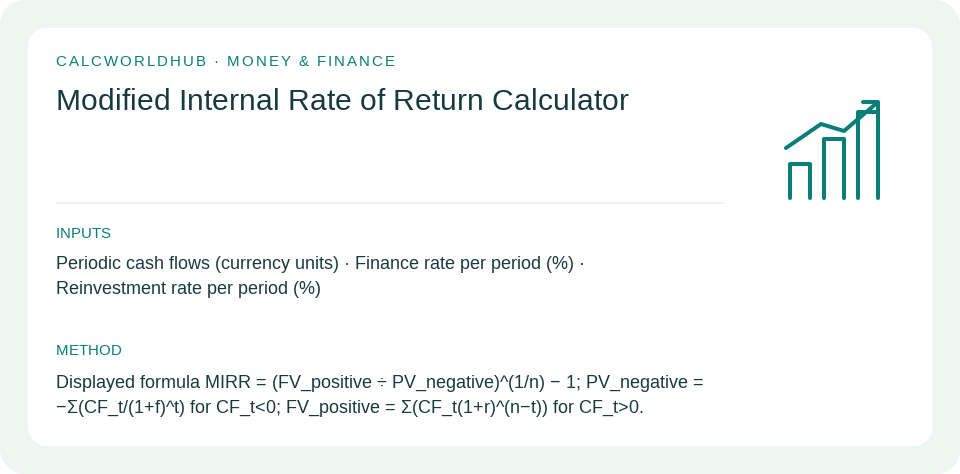
Calculate MIRR from periodic cash flows using separate finance and reinvestment rates.
- Enter Periodic cash flows (currency units), Finance rate per period (%), Reinvestment rate per period (%). Match the units shown beside each field and review the result together with the assumptions below.
- Read the worked example below to check the expected input format and result.
- Compare another scenario by changing one input at a time. Use Reset to return to the starting values.
How this calculation works
MIRR discounts negative cash flows at a finance rate, compounds positive cash flows at a reinvestment rate, and solves the single periodic return connecting those two totals.
Inputs and units
cashFlows— Periodic cash flows (currency units)- Enter period-0 cash flow first, then one cash flow per equal period. Use negative investments and positive receipts.
financeRate— Finance rate per period (%)- Rate used to discount negative cash flows.
reinvestmentRate— Reinvestment rate per period (%)- Rate used to compound positive cash flows to the final period.
Formula
MIRR = (FV_positive ÷ PV_negative)^(1/n) − 1; PV_negative = −Σ(CF_t/(1+f)^t) for CF_t<0; FV_positive = Σ(CF_t(1+r)^(n−t)) for CF_t>0.
Method
Enter one cash flow for period 0 and one for every equal-length period afterward. Use negative amounts for investments, positive amounts for receipts, and rates expressed as percentages per period.
Worked example
For cash flows −120,000; 39,000; 30,000; 21,000; 37,000; and 46,000 with a 10% finance rate and 12% reinvestment rate, the five-period MIRR is 12.61%. Discounting the sole negative flow gives a present value of 120,000; compounding the positive flows at 12% gives a future value of 217,297.50.
Assumptions and limits
Assumes periodic cash flows at equal intervals. The finance and reinvestment rates must be greater than −100% per period, and the cash-flow list must contain at least one positive and one negative amount. MIRR is a model result, not a forecast of realized returns or a substitute for comparing project risk and timing.
Frequently asked questions
Why are there two rates?
MIRR lets the cost of financing negative cash flows differ from the rate used to reinvest positive cash flows.
What does period 0 mean?
It is the starting time before any full interval has elapsed; the initial investment is commonly entered there as a negative amount.
What happens if every cash flow has the same sign?
MIRR is undefined without at least one investment and one receipt, so the calculator asks for both signs.
How do I use the Modified Internal Rate of Return Calculator?
Enter Periodic cash flows (currency units), Finance rate per period (%), Reinvestment rate per period (%). Match the units shown beside each field and review the result together with the assumptions below.
What is a worked example of Modified Internal Rate of Return?
For cash flows −120,000; 39,000; 30,000; 21,000; 37,000; and 46,000 with a 10% finance rate and 12% reinvestment rate, the five-period MIRR is 12.61%. Discounting the sole negative flow gives a present value of 120,000; compounding the positive flows at 12% gives a future value of 217,297.50.
Reference: Microsoft Excel MIRR function: periodic cash flows, finance rate, and reinvestment rate. See our calculation methodology.