How to use this calculator
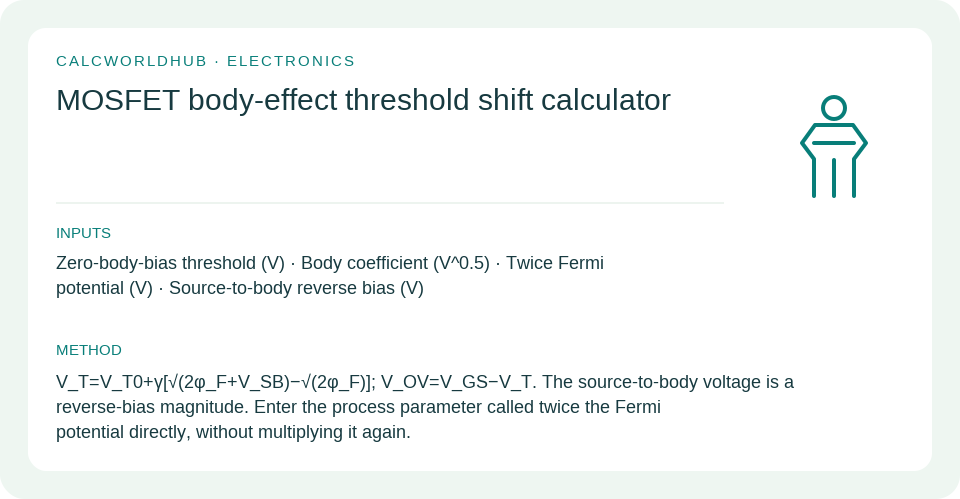
Evaluate threshold increase when an integrated NMOS source rises above its body connection.
- Enter Zero-body-bias threshold (V), Body coefficient (V^0.5), Twice Fermi potential (V), Source-to-body reverse bias (V), then complete the remaining labeled fields. Match the units shown beside each field and review the result together with the assumptions below.
- Read the worked example below to check the expected input format and result.
- Compare another scenario by changing one input at a time. Use Reset to return to the starting values.
MOSFET body-effect threshold shift explained
Reverse bias between the source and body increases the modeled threshold of a bulk NMOS transistor. The body-effect coefficient and twice-Fermi-potential parameter determine that shift; subtracting the shifted threshold from gate-source voltage gives a separate gate-overdrive comparison.
Inputs, symbols, and units
Vt0— Zero-body-bias threshold (V)- Threshold with source and body at equal potential.
gamma— Body coefficient (V^0.5)- Process body-effect coefficient.
phi— Twice Fermi potential (V)- Positive 2 phi F parameter in the threshold relation.
Vsb— Source-to-body reverse bias (V)- Nonnegative source voltage relative to body.
Vgs— Applied gate-source voltage (V)- Gate drive used to report overdrive.
Formula and method
V_T=V_T0+γ[√(2φ_F+V_SB)−√(2φ_F)]; V_OV=V_GS−V_T.
The source-to-body voltage is a reverse-bias magnitude. Enter the process parameter called twice the Fermi potential directly, without multiplying it again.
A worked scenario
Zero-body-bias threshold (V) = 0.6; Body coefficient (V^0.5) = 0.4; Twice Fermi potential (V) = 0.7; Source-to-body reverse bias (V) = 1; Applied gate-source voltage (V) = 1.8.
- Body-biased threshold: 0.786872 V
- Threshold shift: 0.186872 V
- Gate overdrive: 1.013128 V
A 0.6 V zero-bias threshold with gamma 0.4 V^0.5 rises when the source is 1 V above a body whose 2phiF parameter is 0.7 V.
Assumptions and edge cases
Long-channel bulk NMOS approximation. No forward body diode, short-channel threshold effects or temperature adjustment.
Reading the outputs
Negative overdrive indicates that the applied gate bias is below this modeled threshold; it is not a negative physical drain current.
Frequently asked questions
Does a discrete MOSFET usually expose its body terminal?
Often it is tied internally to source, so source-body reverse bias is not independently adjustable.
Why is forward body bias excluded?
The body diode and injection can invalidate this reverse-bias threshold model.
Is negative overdrive a current prediction?
No; it simply compares gate drive with the shifted threshold.
How do I use the MOSFET body-effect threshold shift calculator?
Enter Zero-body-bias threshold (V), Body coefficient (V^0.5), Twice Fermi potential (V), Source-to-body reverse bias (V), then complete the remaining labeled fields. Match the units shown beside each field and review the result together with the assumptions below.
What is a worked example of MOSFET body-effect threshold shift?
Zero-body-bias threshold (V) = 0.6; Body coefficient (V^0.5) = 0.4; Twice Fermi potential (V) = 0.7; Source-to-body reverse bias (V) = 1; Applied gate-source voltage (V) = 1.8. Body-biased threshold: 0.786872 V Threshold shift: 0.186872 V Gate overdrive: 1.013128 V A 0.6 V zero-bias threshold with gamma 0.4 V^0.5 rises when the source is 1 V above a body whose 2phiF parameter is 0.7 V.
Background or definition reference: Analog Devices Chapter 16: MOS body effect.
Read our calculation methodology.