How to use this calculator
Estimate the longer shutter time needed to compensate for a neutral-density filter's optical density.
- Enter Base shutter time without filter (seconds), Neutral-density optical density (OD). Match the units shown beside each field and review the result together with the assumptions below.
- Read the worked example below to check the expected input format and result.
- Compare another scenario by changing one input at a time. Use Reset to return to the starting values.
How this calculation works
A neutral-density filter reduces transmitted light. Optical density (OD) describes that reduction on a base-10 logarithmic scale. Enter the shutter duration without the filter and the filter's OD marking to estimate the compensating shutter duration, transmission, filter factor, and stop reduction. For example, OD 0.9 is approximately a three-stop filter, while OD 3.0 reduces transmission to one-thousandth.
Inputs and units
baseSeconds— Base shutter time without filter (seconds)- Enter exposure duration in seconds; for example, 1/60 s is about 0.016667 s.
opticalDensity— Neutral-density optical density (OD)- Enter the filter's optical density, such as 0.9 for a three-stop ND filter or 3.0 for a 10-stop filter.
Formula
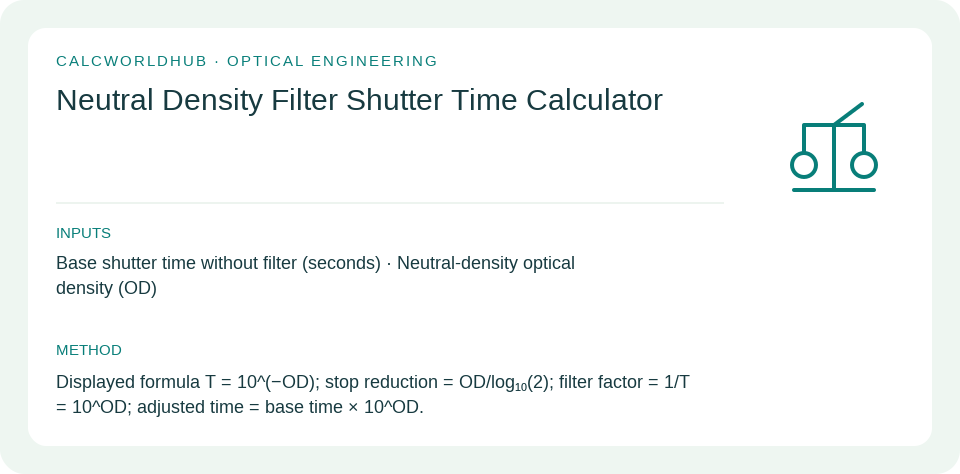
T = 10^(−OD); stop reduction = OD/log₁₀(2); filter factor = 1/T = 10^OD; adjusted time = base time × 10^OD.
Method
Convert optical density to fractional transmission using T = 10^(−OD). The exposure multiplier is the reciprocal of transmission. Convert that multiplier to stops with log₂(filter factor), then multiply the baseline shutter time by the filter factor.
Worked example
A 1/60 s base exposure with an OD 3 filter has a 1000× exposure multiplier, giving an adjusted time of about 16.67 s.
Assumptions and limits
This is an ideal exposure-equivalence estimate for a neutral filter. It does not account for color cast, vignetting, light leaks, variable-filter cross patterns, or reciprocity failure at long exposures. Real filters and cameras may differ slightly from nominal OD markings; verify critical exposures with a test frame or meter.
Frequently asked questions
What does optical density mean?
Optical density is the base-10 logarithm of the inverse of transmission: T = 10^(−OD).
How many stops is an ND filter?
The stop reduction is log₂ of its exposure multiplier. OD 0.3 is about one stop, OD 0.6 about two, and OD 0.9 about three.
Will the calculated long exposure always be exact?
No. Reciprocity behavior, filter tolerances, color cast, and stray light can affect long exposures, so use the result as a starting estimate and test when precision matters.
How do I use the Neutral Density Filter Shutter Time Calculator?
Enter Base shutter time without filter (seconds), Neutral-density optical density (OD). Match the units shown beside each field and review the result together with the assumptions below.
What is a worked example of Neutral Density Filter Shutter Time?
A 1/60 s base exposure with an OD 3 filter has a 1000× exposure multiplier, giving an adjusted time of about 16.67 s.
Reference: Thorlabs neutral-density filter catalog defining optical density and transmission. See our calculation methodology.