How to use this calculator
Calculate a periodic-review order-up-to target and suggested order quantity over the review-plus-lead protection interval.
- Enter Mean daily demand, Daily demand standard deviation, Review interval, Constant lead time, then complete the remaining labeled fields. Match the units shown beside each field and review the result together with the assumptions below.
- Read the worked example below to check the expected input format and result.
- Compare another scenario by changing one input at a time. Use Reset to return to the starting values.
Cover the full review-plus-lead protection interval
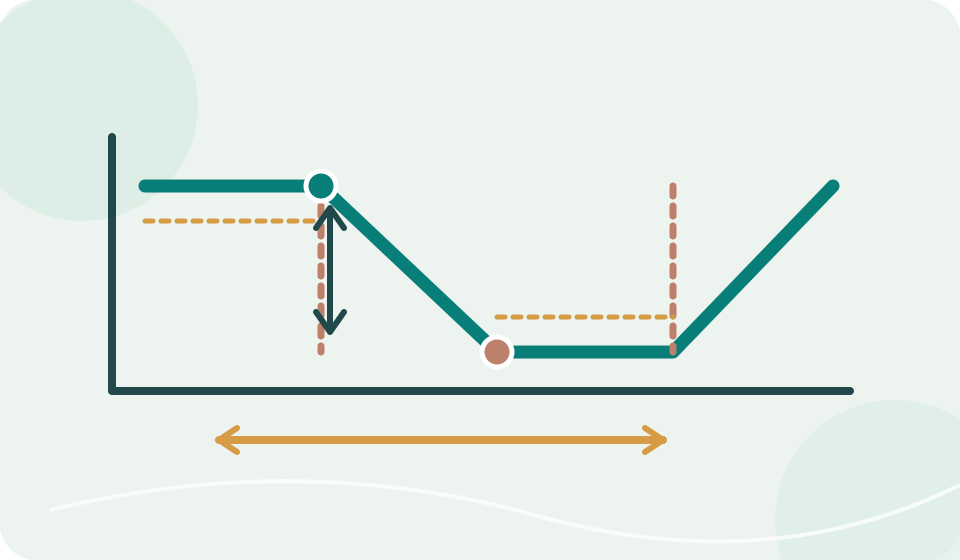
With periodic review, stock may wait until the next review before an order is placed. The target therefore covers demand across both the review interval and supplier lead time, plus a safety buffer for demand variation.
Inputs and units
- Mean daily demand: Average units consumed per day.
- Daily demand standard deviation: Day-to-day demand spread, in the same units/day basis.
- Review interval: Days between inventory reviews.
- Constant lead time: Days from placing the order until replenishment arrives.
- Normal safety factor z: A chosen standard-normal multiplier for the buffer; this is not itself a service guarantee.
- Current inventory position: On-hand stock plus on-order units minus backorders; the calculator uses this to show a suggested order quantity after the target.
Formula and method
Let P = review interval + lead time. The target is S = μP + zσ√P for independent daily demand, fixed lead time, and the normal approximation. The suggested order is max(0, S − inventory position); the page displays the continuous quantity without rounding it to pack sizes.
Worked example
For μ = 20 units/day, σ = 5 units/day, a 7-day review interval, 3-day lead time, and z = 1.645, P = 10 days. Expected demand is 20 × 10 = 200 units; the buffer is 1.645 × 5 × √10 = 26.0097 units. Thus S = 226.0097. With inventory position 100, the suggested continuous order is 226.0097 − 100 = 126.0097 units.
Interpreting the result
The order-up-to target is the inventory position the replenishment system aims to reach. The suggested quantity is the gap between that target and the position entered; a real order may need adjustment for pack size, minimums, or a different service policy.
Assumptions and limits
Daily demands are treated as independent with a stable mean and standard deviation, lead time is fixed, and demand over the protection interval is approximated as normal. Lead-time variability, trends, seasonality, lost sales, and supplier constraints are not modeled.
Method references
- INFLIBNET University: periodic-review inventory systems
- Oracle JD Edwards: periodic review calculation concepts
Frequently asked questions
Why does the buffer use review interval plus lead time?
A periodic-review system cannot place the next order until the next review, so protection must span the wait to that review and the subsequent replenishment lead time.
How do I use the Periodic review order up to level calculator?
Enter Mean daily demand, Daily demand standard deviation, Review interval, Constant lead time, then complete the remaining labeled fields. Match the units shown beside each field and review the result together with the assumptions below.
What is a worked example of Periodic review order up to level?
For μ = 20 units/day, σ = 5 units/day, a 7-day review interval, 3-day lead time, and z = 1.645, P = 10 days. Expected demand is 20 × 10 = 200 units; the buffer is 1.645 × 5 × √10 = 26.0097 units. Thus S = 226.0097. With inventory position 100, the suggested continuous order is 226.0097 − 100 = 126.0097 units.
What does the Periodic review order up to level calculator calculate?
Calculate a periodic-review order-up-to target and suggested order quantity over the review-plus-lead protection interval.
What assumptions apply to Periodic review order up to level?
Daily demands are treated as independent with a stable mean and standard deviation, lead time is fixed, and demand over the protection interval is approximated as normal. Lead-time variability, trends, seasonality, lost sales, and supplier constraints are not modeled.