PERT task duration standard deviation calculator
Estimate the conventional PERT duration spread from the task range.
inputs.
Calculator


How to use this calculator
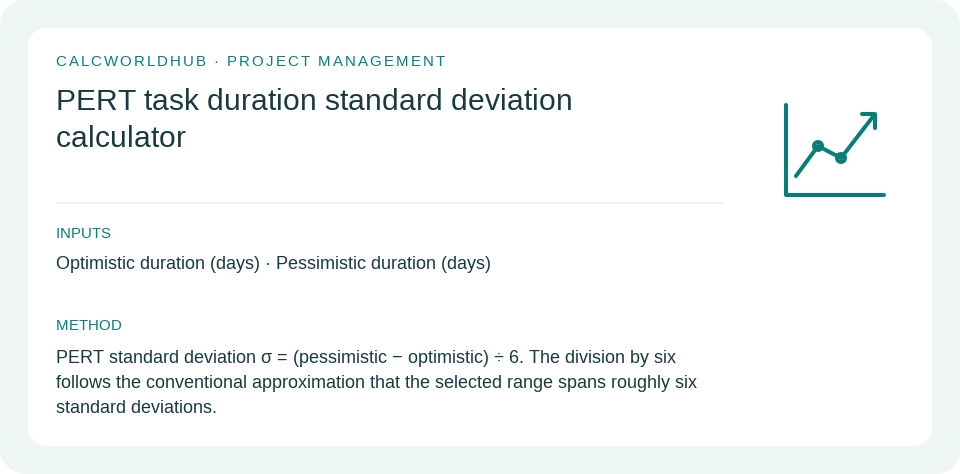
Estimate PERT task-duration standard deviation from optimistic and pessimistic durations.
- Enter Optimistic duration (days), Pessimistic duration (days). Match the units shown beside each field and review the result together with the assumptions below.
- Read the worked example below to check the expected input format and result.
- Compare another scenario by changing one input at a time. Use Reset to return to the starting values.
Estimate PERT duration spread from optimistic and pessimistic bounds
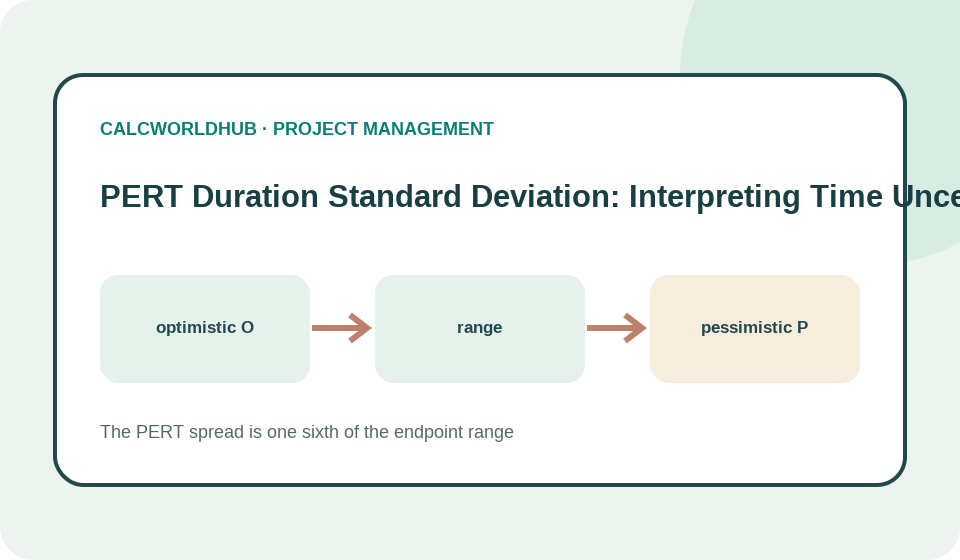
The classical PERT approximation estimates duration standard deviation from the optimistic and pessimistic time bounds. The most-likely estimate contributes to expected duration, but not to this simple spread formula.
Inputs and units
- Optimistic duration (days): Low but plausible duration under the selected task assumptions.
- Pessimistic duration (days): High but plausible duration under the same task assumptions; it must not be below the optimistic estimate.
Formula and method
PERT standard deviation σ = (pessimistic − optimistic) ÷ 6. The division by six follows the conventional approximation that the selected range spans roughly six standard deviations.
Worked example
For an optimistic duration of 3 days and a pessimistic duration of 11 days, σ = (11−3)/6 = 1.3333 days. A separate PERT expected-duration estimate uses the most-likely value.
Interpreting the result
The result is an estimated spread in days, not a deadline probability by itself. A probability calculation also needs an expected duration and assumptions about the duration distribution.
Assumptions and limits
The range and six-sigma convention are planning assumptions, not a statistical confidence interval. This page does not model dependencies, correlated risks, or empirical task-duration data.
Method references
Frequently asked questions
Why is most-likely duration not an input?
It affects the conventional PERT expected duration, but the standard-deviation approximation uses only the optimistic and pessimistic bounds.
How do I use the PERT task duration standard deviation calculator?
Enter Optimistic duration (days), Pessimistic duration (days). Match the units shown beside each field and review the result together with the assumptions below.
What is a worked example of PERT task duration standard deviation?
For an optimistic duration of 3 days and a pessimistic duration of 11 days, σ = (11−3)/6 = 1.3333 days. A separate PERT expected-duration estimate uses the most-likely value.
What does the PERT task duration standard deviation calculator calculate?
Estimate PERT task-duration standard deviation from optimistic and pessimistic durations.
What assumptions apply to PERT task duration standard deviation?
The range and six-sigma convention are planning assumptions, not a statistical confidence interval. This page does not model dependencies, correlated risks, or empirical task-duration data.
Good calculators show their work.
CalcWorldHub is built around clear inputs and visible assumptions. Results are estimates for planning; check official sources or your provider’s terms when exact figures matter.