How to use this calculator
Estimate constant-current runtime for a lead-acid battery using its rated capacity, rating period, and Peukert exponent.
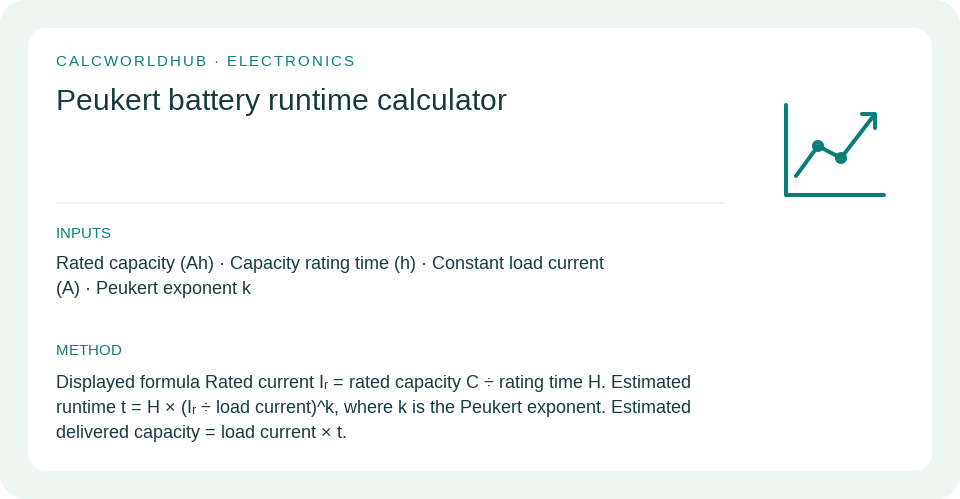
- Enter Rated capacity (Ah), Capacity rating time (h), Constant load current (A), Peukert exponent k. Match the units shown beside each field and review the result together with the assumptions below.
- Read the worked example below to check the expected input format and result.
- Compare another scenario by changing one input at a time. Use Reset to return to the starting values.
How this calculation works
A battery’s amp-hour rating depends on the discharge rate used for the rating. Peukert’s empirical model estimates how available capacity changes under a different constant current, which helps compare a load with the battery’s stated rating.
Inputs and units
capacity— Rated capacity (Ah)- Amp-hour capacity specified at the entered rating period.
ratingHours— Capacity rating time (h)- Discharge duration used for the capacity rating, such as 20 hours.
loadCurrent— Constant load current (A)- Average battery discharge current over the modeled interval.
exponent— Peukert exponent k- Empirical exponent for this battery and operating condition.
Formula
Rated current Iᵣ = rated capacity C ÷ rating time H. Estimated runtime t = H × (Iᵣ ÷ load current)^k, where k is the Peukert exponent. Estimated delivered capacity = load current × t.
Worked example
A 100 Ah battery rated at 20 hours has a rated test current of 5 A. With a 10 A load and k = 1.2, estimated runtime is 20 × (5/10)^1.2 ≈ 8.706 hours.
Assumptions and limits
This empirical approximation is mainly used for lead-acid batteries at approximately constant current and temperature. It does not model voltage cutoff, aging, temperature variation, variable loads, or battery-management limits.
Frequently asked questions
Why is runtime shorter at a higher current?
Peukert’s model represents the reduced available amp-hour capacity of a lead-acid battery as discharge current increases.
Where should I get the exponent?
Use a value measured for the battery or supplied by its manufacturer; it varies by battery and test conditions.
Can I use this for a changing load?
This version assumes approximately constant current. Variable loads need a model that accounts for the current profile and voltage cutoff.
How do I use the Peukert battery runtime calculator?
Enter Rated capacity (Ah), Capacity rating time (h), Constant load current (A), Peukert exponent k. Match the units shown beside each field and review the result together with the assumptions below.
What is a worked example of Peukert battery runtime?
A 100 Ah battery rated at 20 hours has a rated test current of 5 A. With a 10 A load and k = 1.2, estimated runtime is 20 × (5/10)^1.2 ≈ 8.706 hours.
Reference: technical reference. See our calculation methodology.