How to use this calculator
Estimate how one centrifugal pump's flow, head, and power at a known operating point scale when rotational speed changes.
- Enter Baseline rotational speed N₁ (rpm), New rotational speed N₂ (rpm), Baseline flow Q₁ (m³/h), Baseline head H₁ (m), then complete the remaining labeled fields. Match the units shown beside each field and review the result together with the assumptions below.
- Read the worked example below to check the expected input format and result.
- Compare another scenario by changing one input at a time. Use Reset to return to the starting values.
How this calculation works
The pump affinity relationships provide a first estimate of a homologous pump point after a speed change: flow scales with speed, head with the square of speed, and power with its cube. The result is useful for a quick variable-speed scenario before checking the actual system and manufacturer's curves.
Inputs and units
speed1— Baseline rotational speed N₁ (rpm)- Speed corresponding to the entered baseline pump performance point.
speed2— New rotational speed N₂ (rpm)- Scenario speed for the same pump and impeller geometry.
flow1— Baseline flow Q₁ (m³/h)- Flow at the baseline homologous pump point.
head1— Baseline head H₁ (m)- Total pump head at the baseline point.
power1— Baseline pump power P₁ (kW)- Power corresponding to the baseline point, using a consistent definition for comparison.
Formula
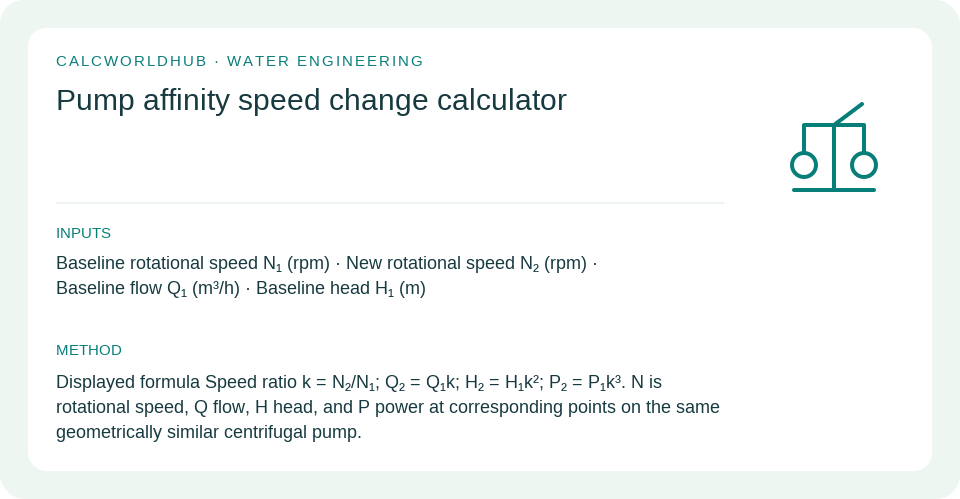
Speed ratio k = N₂/N₁; Q₂ = Q₁k; H₂ = H₁k²; P₂ = P₁k³. N is rotational speed, Q flow, H head, and P power at corresponding points on the same geometrically similar centrifugal pump.
Method
The calculator applies the speed-only affinity ratios to a baseline pump point. It does not solve the intersection between the changed pump curve and a system curve, so the scaled point is not automatically the actual field operating point.
Worked example
At a baseline speed of 3,000 rpm, a 2,700 rpm scenario gives k = 0.90. A baseline point of 10 m³/h, 40 m head, and 2.4 kW scales to about 9.0 m³/h, 32.4 m, and 1.7496 kW.
Assumptions and limits
This is an approximate similarity estimate for the same centrifugal-pump geometry and fluid. It assumes comparable efficiency and a noncavitating, incompressible operating range; it excludes motor and drive efficiency, minimum-flow constraints, system resistance, control limits, and changes in the pump curve. Confirm the operating point against manufacturer data before equipment changes.
Frequently asked questions
Why does power change faster than flow?
Under the similarity approximation, flow scales with k, head with k², and power with k³, so modest speed changes can have a larger idealized power effect.
Is the scaled flow the final system flow?
Not necessarily. Actual flow is found where the changed pump curve intersects the system curve; this tool only scales one homologous pump point.
Does the estimate include efficiency changes?
No. It applies ideal affinity ratios and does not model efficiency, drive losses, cavitation, or operating constraints.
Can I use it for an impeller trim?
This page scales rotational speed only. Impeller-diameter changes have additional applicability limits and should be checked against pump manufacturer guidance.
How do I use the Pump affinity speed change calculator?
Enter Baseline rotational speed N₁ (rpm), New rotational speed N₂ (rpm), Baseline flow Q₁ (m³/h), Baseline head H₁ (m), then complete the remaining labeled fields. Match the units shown beside each field and review the result together with the assumptions below.
Reference: Wilo pump affinity laws for speed-related flow, head, and power scaling. See our calculation methodology.