How to use this calculator
Calculate a dimensionless bed-grain shear ratio from grain shear stress, densities, and median diameter.
- Enter Grain-related bed shear stress τb (Pa), Sediment grain density ρs (kg/m³), Fluid density ρf (kg/m³), Median grain diameter d50 (mm), then complete the remaining labeled fields. Match the units shown beside each field and review the result together with the assumptions below.
- Read the worked example below to check the expected input format and result.
- Compare another scenario by changing one input at a time. Use Reset to return to the starting values.
How this calculation works
The Shields parameter compares the shear stress acting on noncohesive sediment grains with the submerged weight scale of a representative grain. This page computes the parameter for the supplied grain-related bed shear stress and median grain diameter. It reports the dimensionless ratio only; it does not choose a critical threshold or infer that sediment is moving.
Inputs and units
tau— Grain-related bed shear stress τb (Pa)- Bed shear stress acting on the noncohesive grains, not total reach-mean boundary stress.
rhoSolid— Sediment grain density ρs (kg/m³)- Density of the noncohesive sediment grains.
rhoFluid— Fluid density ρf (kg/m³)- Density of the surrounding fluid.
d50— Median grain diameter d50 (mm)- Representative median grain diameter in millimeters.
g— Gravitational acceleration g (m/s²)- Local gravitational acceleration.
Formula
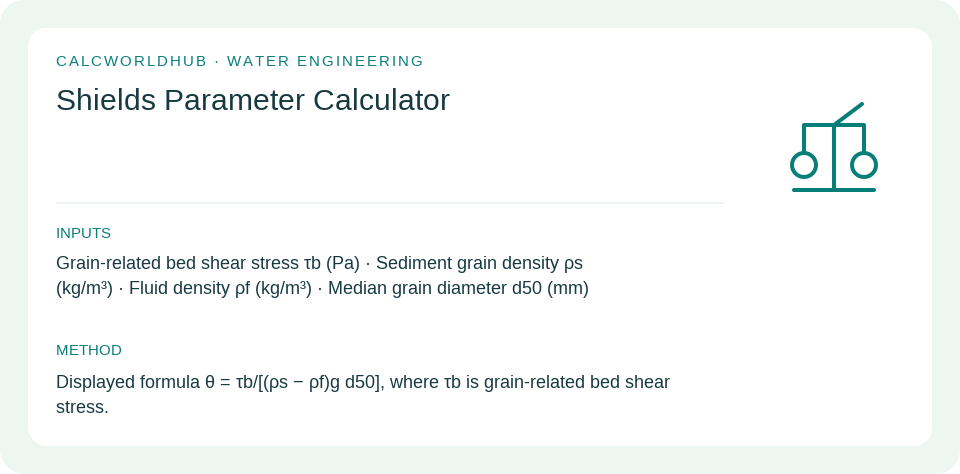
θ = τb/[(ρs − ρf)g d50], where τb is grain-related bed shear stress.
Method
Convert d50 from millimeters to meters, calculate the submerged-density difference ρs − ρf, multiply by gravity and grain size, then divide the entered grain shear stress by that denominator.
Worked example
For τb = 0.50 Pa, ρs = 2,650 kg/m³, ρf = 1,000 kg/m³, d50 = 0.50 mm, and g = 9.80665 m/s², θ = 0.06180.
Assumptions and limits
Use grain-related bed shear stress, not a reach-mean boundary stress that includes form drag or other resistance. Critical Shields values depend on grain size, flow, packing, and the selected transport model, so no universal motion threshold is applied.
Frequently asked questions
Does a Shields value above one fixed number mean the bed moves?
No single critical value is applied here. The relevant threshold depends on grain size and the transport or incipient-motion model.
Which shear stress should I enter?
Use the shear attributed to the grains. A reach-mean channel stress that includes form drag can overstate the stress available to move grains.
Why is the fluid density subtracted from grain density?
The denominator represents submerged grain weight per unit area, so it uses the density difference between sediment and fluid.
How do I use the Shields Parameter Calculator?
Enter Grain-related bed shear stress τb (Pa), Sediment grain density ρs (kg/m³), Fluid density ρf (kg/m³), Median grain diameter d50 (mm), then complete the remaining labeled fields. Match the units shown beside each field and review the result together with the assumptions below.
What is a worked example of Shields Parameter?
For τb = 0.50 Pa, ρs = 2,650 kg/m³, ρf = 1,000 kg/m³, d50 = 0.50 mm, and g = 9.80665 m/s², θ = 0.06180.
Reference: USACE HEC-RAS sediment-transport critical Shields parameter guidance. See our calculation methodology.