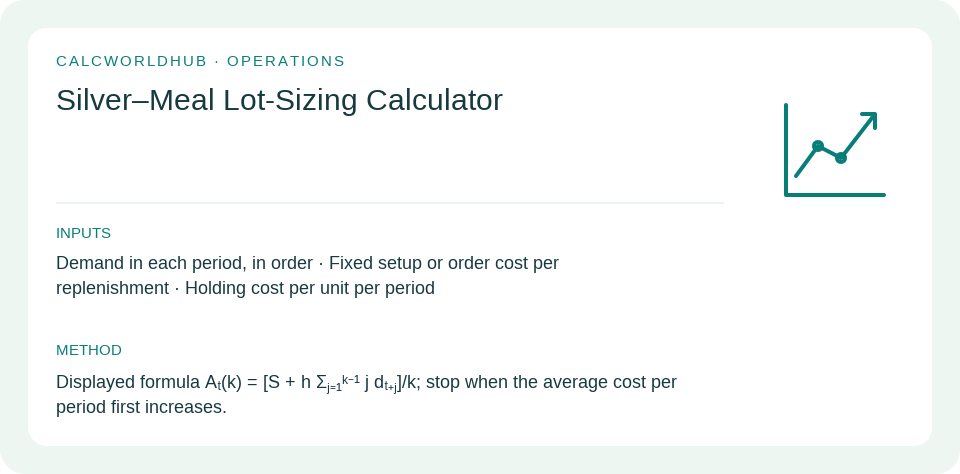
How to use this calculator
Build a forward lot-size plan by extending each order until average cost per period first rises.
- Enter Demand in each period, in order, Fixed setup or order cost per replenishment, Holding cost per unit per period. Match the units shown beside each field and review the result together with the assumptions below.
- Read the worked example below to check the expected input format and result.
- Compare another scenario by changing one input at a time. Use Reset to return to the starting values.
How this calculation works
Silver–Meal is a deterministic, uncapacitated lot-sizing heuristic for known time-phased demand. At each uncovered period it compares the setup plus holding cost per covered period as the order horizon grows, then places an order for the best horizon before continuing.
Inputs and units
demands— Demand in each period, in order- Enter 1 to 50 nonnegative demands separated by commas or spaces.
setupCost— Fixed setup or order cost per replenishment- Use one currency unit consistently.
holdingCost— Holding cost per unit per period- Charge applies for each period an item is carried after receipt.
Formula
Aₜ(k) = [S + h Σⱼ₌₁ᵏ⁻¹ j dₜ₊ⱼ]/k; stop when the average cost per period first increases.
Method
Starting at the first period with positive uncovered demand, calculate setup cost plus the holding cost for later-period demand for horizons of 1, 2, … periods. If the average first increases, order the demand in the preceding best horizon. Repeat through the demand list.
Worked example
For demands 80, 50, 70, and 40 with a setup cost of 120 and holding cost of 2 per unit per period, the heuristic orders 130 units in period 1 and 110 in period 3. Setup cost is 240, holding cost is 180, and total relevant cost is 420.
Assumptions and limits
Demand is deterministic, periods are equal, replenishment is immediate, there is no capacity limit or backlogging, and the same setup and per-unit holding costs apply throughout. Holding cost starts after the receipt period. Silver–Meal is a heuristic and does not guarantee a globally minimum total cost.
Frequently asked questions
Does Silver–Meal always find the cheapest full-horizon plan?
No. It is a forward heuristic that chooses each replenishment horizon from average cost per period.
How is later-period demand charged?
A unit needed one period after receipt incurs one period of holding cost; a unit needed two periods later incurs two.
What happens in a zero-demand period?
The calculator skips it as an order start. Later demand may still be covered by an earlier replenishment if the heuristic selects that horizon.
How do I use the Silver–Meal Lot-Sizing Calculator?
Enter Demand in each period, in order, Fixed setup or order cost per replenishment, Holding cost per unit per period. Match the units shown beside each field and review the result together with the assumptions below.
What is a worked example of Silver–Meal Lot-Sizing?
For demands 80, 50, 70, and 40 with a setup cost of 120 and holding cost of 2 per unit per period, the heuristic orders 130 units in period 1 and 110 in period 3. Setup cost is 240, holding cost is 180, and total relevant cost is 420.
Reference: technical reference. See our calculation methodology.