How to use this calculator
Reduce a corrected soil hydrometer reading to equivalent particle diameter and percent finer in the total sample.
- Enter Corrected hydrometer reading, R_c (g/L), Sedimentation-cylinder volume, V (L), Specific-gravity correction factor, a, Oven-dry dispersed soil mass, W_s (g), then complete the remaining labeled fields. Match the units shown beside each field and review the result together with the assumptions below.
- Read the worked example below to check the expected input format and result.
- Compare another scenario by changing one input at a time. Use Reset to return to the starting values.
How this calculation works
For one sedimentation reading, enter the corrected 152H-style concentration, dry dispersed sample mass, calibrated effective depth, elapsed time, and water kinematic viscosity. The calculator returns an equivalent Stokes diameter and scales the suspended fraction to the original sample using the percent passing the 2.00 mm sieve.
Inputs and units
correctedReadingGL— Corrected hydrometer reading, R_c (g/L)- 152H-style soil concentration after the method's meniscus, temperature, and blank/dispersant corrections.
suspensionVolumeL— Sedimentation-cylinder volume, V (L)- Total suspension volume represented by the corrected concentration reading.
specificGravityFactorA— Specific-gravity correction factor, a- Use the value from the applicable method table; a is 1.0 when soil specific gravity is 2.65.
drySampleMassG— Oven-dry dispersed soil mass, W_s (g)- Oven-dry mass of the dispersed fine-soil portion tested in the cylinder.
percentPassing2Mm— Percent passing 2.00 mm sieve, Z (%)- Percent of the original total sample passing the 2.00 mm sieve, used to scale the hydrometer fraction.
effectiveDepthCm— Calibrated effective depth, H (cm)- Distance from the suspension surface to the measurement depth for this corrected hydrometer reading.
elapsedTimeMin— Elapsed sedimentation time, t (min)- Time from the start of sedimentation to this hydrometer reading.
soilSpecificGravity— Specific gravity of soil solids, G_s- Specific gravity of the soil particles used in Stokes' settling relation.
waterKinematicViscosityMm2s— Water kinematic viscosity, ν (mm²/s)- Water kinematic viscosity at the measured suspension temperature; 1.004 mm²/s is approximately the value at 20°C.
Formula
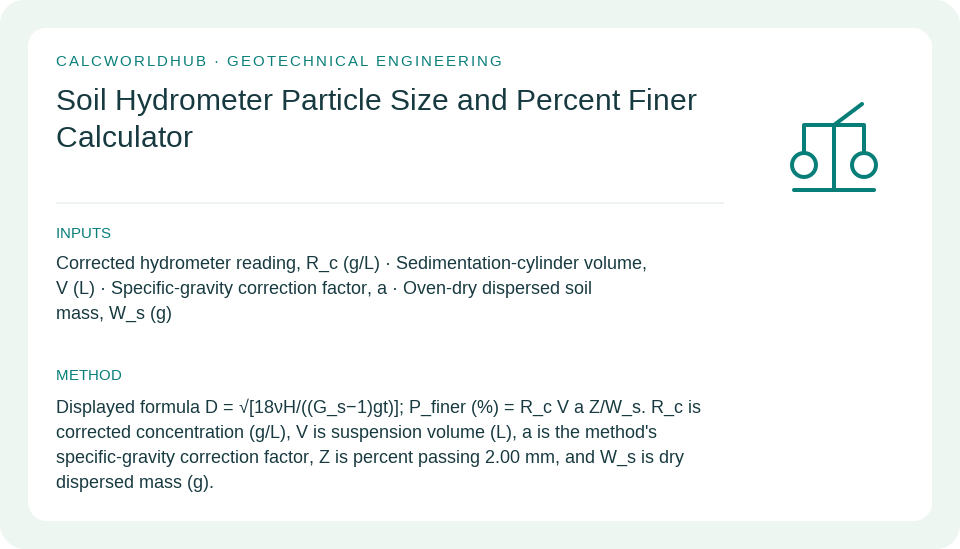
D = √[18νH/((G_s−1)gt)]; P_finer (%) = R_c V a Z/W_s. R_c is corrected concentration (g/L), V is suspension volume (L), a is the method's specific-gravity correction factor, Z is percent passing 2.00 mm, and W_s is dry dispersed mass (g).
Method
Use a pre-corrected hydrometer reading in grams per liter and the effective depth from the calibration table for that reading. Apply Stokes settling with the stated water kinematic viscosity to estimate equivalent spherical diameter. Convert the suspension reading to the percentage of soil still in suspension, then multiply by Z/100 to express percent finer on the total-sample basis.
Worked example
For a corrected reading of 16.8 g/L in a 1 L cylinder, a = 1, W_s = 48.95 g, and Z = 96.6%, percent finer is 33.1538%. With H = 10 cm, t = 2 min, G_s = 2.65, and ν = 1.004 mm²/s, the equivalent Stokes diameter is 0.0305077 mm.
Assumptions and limits
This reduces one measurement point; it does not prepare a complete particle-size distribution curve or perform hydrometer corrections. Enter a corrected 152H-style g/L reading, calibrated effective depth, and the applicable specific-gravity factor a (a = 1 at G_s = 2.65). Stokes diameter assumes dilute, laminar settling of equivalent spheres. Combine the fine fraction with sieve results and follow ASTM D7928/AASHTO T 88 requirements for the actual test.
Frequently asked questions
What does equivalent Stokes diameter mean?
It is the diameter of an ideal sphere with the same specific gravity that would settle through the stated depth in the entered time under Stokes assumptions.
Why use the percent passing the 2.00 mm sieve?
The hydrometer reading describes the dispersed fine fraction. The sieve passing percentage scales that result back to the original total sample.
Does this calculate the full gradation curve?
No. It reduces one reading point. Repeat with each corrected reading and combine the points with sieve-analysis results to build the full curve.
How do I use the Soil Hydrometer Particle Size and Percent Finer Calculator?
Enter Corrected hydrometer reading, R_c (g/L), Sedimentation-cylinder volume, V (L), Specific-gravity correction factor, a, Oven-dry dispersed soil mass, W_s (g), then complete the remaining labeled fields. Match the units shown beside each field and review the result together with the assumptions below.
What is a worked example of Soil Hydrometer Particle Size and Percent Finer?
For a corrected reading of 16.8 g/L in a 1 L cylinder, a = 1, W_s = 48.95 g, and Z = 96.6%, percent finer is 33.1538%. With H = 10 cm, t = 2 min, G_s = 2.65, and ν = 1.004 mm²/s, the equivalent Stokes diameter is 0.0305077 mm.
Reference: Minnesota DOT Laboratory Manual 1302 hydrometer correction and percent-finer calculation. See our calculation methodology.