How to use this calculator
Estimate MPPT battery-side charging current from PV power, charge voltage, conversion efficiency, and a planning margin.
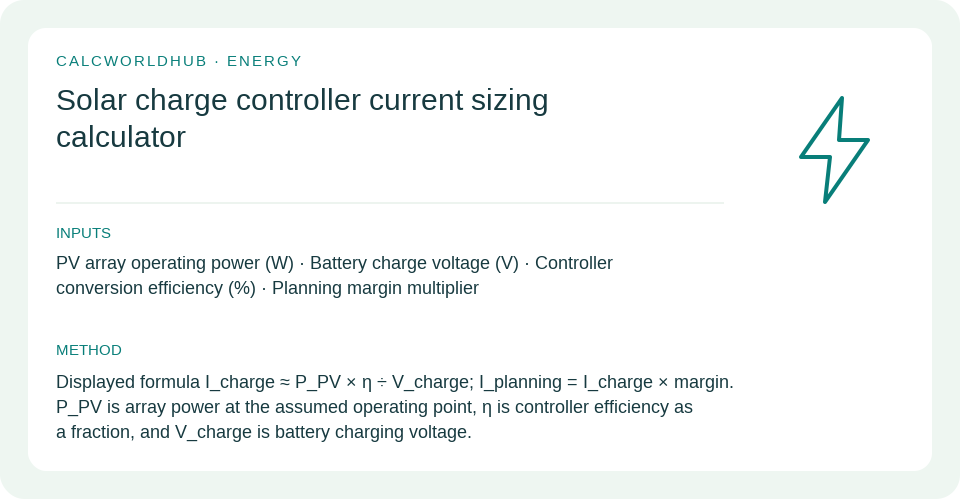
- Enter PV array operating power (W), Battery charge voltage (V), Controller conversion efficiency (%), Planning margin multiplier. Match the units shown beside each field and review the result together with the assumptions below.
- Read the worked example below to check the expected input format and result.
- Compare another scenario by changing one input at a time. Use Reset to return to the starting values.
How this calculation works
An MPPT controller converts array power into battery-side charging current, so the current estimate depends on the actual charge voltage as well as array wattage. This tool gives a planning value and a user-selected headroom estimate for comparing controller output-current ratings.
Inputs and units
pvPowerW— PV array operating power (W)- Power expected from the array at the chosen operating condition, not the sum of arbitrary peak ratings.
chargeVoltageV— Battery charge voltage (V)- Use the battery-side voltage during the charge stage being checked.
efficiencyPercent— Controller conversion efficiency (%)- Enter an efficiency from 1 to 100 percent; use the manufacturer's value for the operating point if available.
planningMargin— Planning margin multiplier- A user-selected sizing factor. For example, 1.25 adds 25% headroom; it is not a code requirement.
Formula
I_charge ≈ P_PV × η ÷ V_charge; I_planning = I_charge × margin. P_PV is array power at the assumed operating point, η is controller efficiency as a fraction, and V_charge is battery charging voltage.
Method
Enter the PV array power, battery charging voltage at the operating condition, controller conversion efficiency, and a planning multiplier. The planning current is not a product recommendation; compare it with the controller's rated output current and input limits.
Worked example
For 2,000 W of PV power, 97% conversion efficiency, and 52 V charge voltage, estimated output is 37.31 A. A chosen 1.25 planning multiplier gives about 46.63 A for rating comparison.
Assumptions and limits
This is a power-balance estimate for an MPPT controller. It does not check maximum PV open-circuit voltage, short-circuit current, string configuration, temperature derating, battery chemistry limits, wiring, or local electrical code. Controllers may clip output at their rating; verify the selected model's manual and system design.
Frequently asked questions
Why does battery voltage affect controller output current?
For roughly the same converted power, lower battery-side voltage corresponds to higher output current.
Is the planning multiplier a required safety factor?
No. It is an explicit user input for comparison and headroom planning; follow the selected controller's instructions and applicable electrical rules.
Does this confirm that my PV strings fit the controller?
No. Verify cold-weather open-circuit voltage, array short-circuit current, connector limits, and battery charge settings separately.
How do I use the Solar charge controller current sizing calculator?
Enter PV array operating power (W), Battery charge voltage (V), Controller conversion efficiency (%), Planning margin multiplier. Match the units shown beside each field and review the result together with the assumptions below.
What is a worked example of Solar charge controller current sizing?
For 2,000 W of PV power, 97% conversion efficiency, and 52 V charge voltage, estimated output is 37.31 A. A chosen 1.25 planning multiplier gives about 46.63 A for rating comparison.
Reference: Victron MPPT controller manual. See our calculation methodology.