How to use this calculator
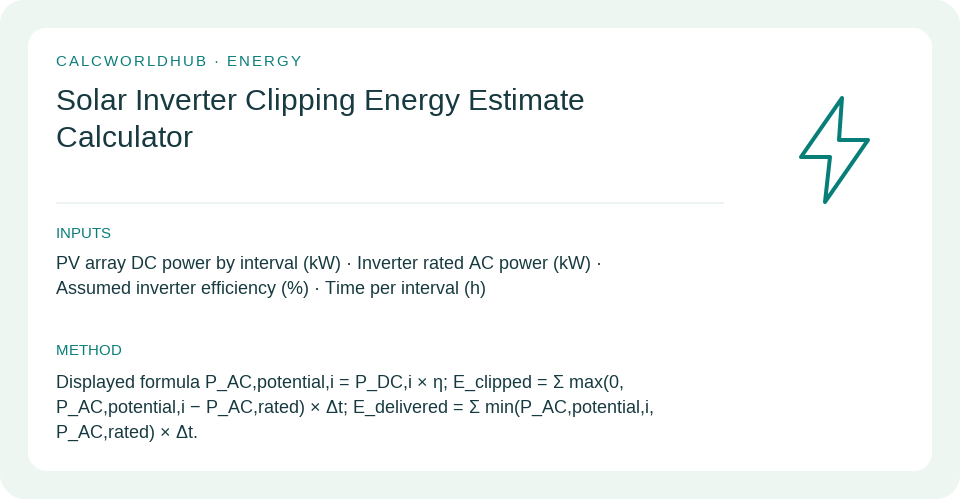
Estimate clipped AC energy from a time series of PV DC output, inverter rating, efficiency, and interval length.
- Enter PV array DC power by interval (kW), Inverter rated AC power (kW), Assumed inverter efficiency (%), Time per interval (h). Match the units shown beside each field and review the result together with the assumptions below.
- Read the worked example below to check the expected input format and result.
- Compare another scenario by changing one input at a time. Use Reset to return to the starting values.
How this calculation works
When the array could deliver more AC-equivalent power than the inverter's rated AC output, the excess is clipped. This profile calculation sums the difference at each equal time interval, so it reflects how often the power profile crosses the inverter limit.
Inputs and units
dcPower— PV array DC power by interval (kW)- One nonnegative DC power value per equal interval, in chronological order.
inverterAcRating— Inverter rated AC power (kW)- Hard AC output limit used in this simplified estimate.
inverterEfficiencyPct— Assumed inverter efficiency (%)- Constant DC-to-AC conversion efficiency applied before clipping.
intervalHours— Time per interval (h)- Equal duration represented by every DC power value.
Formula
P_AC,potential,i = P_DC,i × η; E_clipped = Σ max(0, P_AC,potential,i − P_AC,rated) × Δt; E_delivered = Σ min(P_AC,potential,i, P_AC,rated) × Δt.
Method
Enter one PV array DC power value for each equally spaced interval, plus inverter AC rating, assumed constant conversion efficiency, and interval duration. All power values must use kW and time must use hours.
Worked example
For hourly DC powers 2, 4, 6, and 8 kW, a 5 kW inverter, 96% efficiency, and 1-hour intervals, potential AC energy is 19.20 kWh, clipped energy is 3.44 kWh, delivered AC energy is 15.76 kWh, and the clipped share is 17.92%.
Assumptions and limits
This is a simplified clipping estimate using a constant inverter efficiency and a hard AC power limit. It does not model temperature, voltage window, MPPT behavior, startup/shutdown, reactive-power limits, soiling, availability, or detailed inverter efficiency curves. Use a validated PV simulation for annual production estimates.
Frequently asked questions
Why does a DC/AC ratio not give clipped energy?
Clipping depends on how often the time-varying array output exceeds the inverter limit, not only on the two nameplate ratings.
Can daily or monthly averages replace hourly values?
Averages can hide short periods above the inverter rating and may understate clipping. Use intervals fine enough for the profile you want to estimate.
Is this a full PV production model?
No. It isolates a simple hard-limit effect with fixed efficiency and does not model weather, module temperature, or inverter operating curves.
How do I use the Solar Inverter Clipping Energy Estimate Calculator?
Enter PV array DC power by interval (kW), Inverter rated AC power (kW), Assumed inverter efficiency (%), Time per interval (h). Match the units shown beside each field and review the result together with the assumptions below.
What is a worked example of Solar Inverter Clipping Energy Estimate?
For hourly DC powers 2, 4, 6, and 8 kW, a 5 kW inverter, 96% efficiency, and 1-hour intervals, potential AC energy is 19.20 kWh, clipped energy is 3.44 kWh, delivered AC energy is 15.76 kWh, and the clipped share is 17.92%.
Reference: NREL System Advisor Model help on PV inverter output clipping at rated AC power. See our calculation methodology.