How to use this calculator
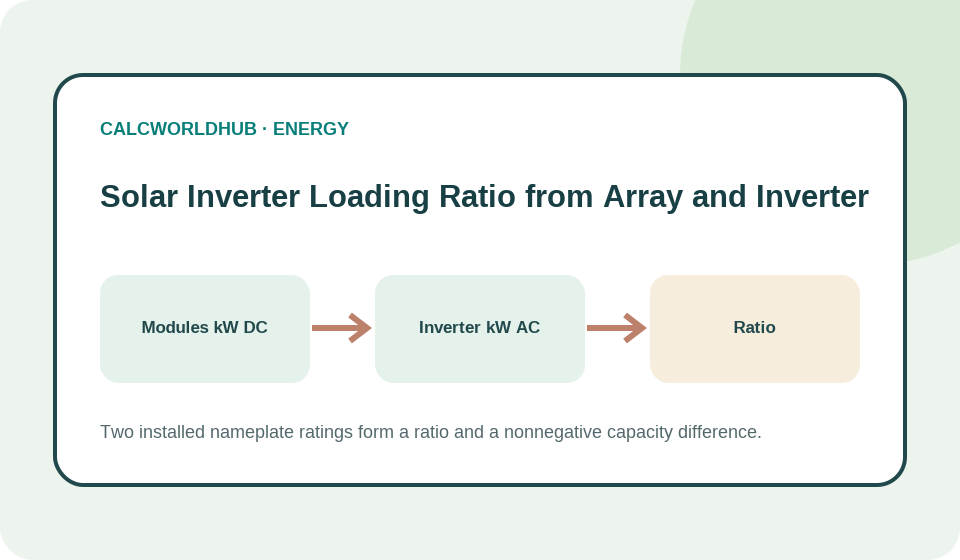
Calculate the ratio of a solar array’s DC nameplate capacity to the connected inverter’s AC rating.
- Enter PV module capacity (kW DC), Inverter capacity (kW AC). Match the units shown beside each field and review the result together with the assumptions below.
- Read the worked example below to check the expected input format and result.
- Compare another scenario by changing one input at a time. Use Reset to return to the starting values.
How this calculation works
The inverter loading ratio (ILR), also called the DC-to-AC ratio, compares the photovoltaic modules’ rated direct-current capacity with the inverter’s rated alternating-current capacity. System designers use it as a sizing descriptor; it does not by itself predict annual energy or clipping losses.
Inputs and units
dcKw— PV module capacity (kW DC)- Sum of module nameplate ratings under the stated rating convention.
acKw— Inverter capacity (kW AC)- Combined rated AC output capacity of the connected inverters.
Formula
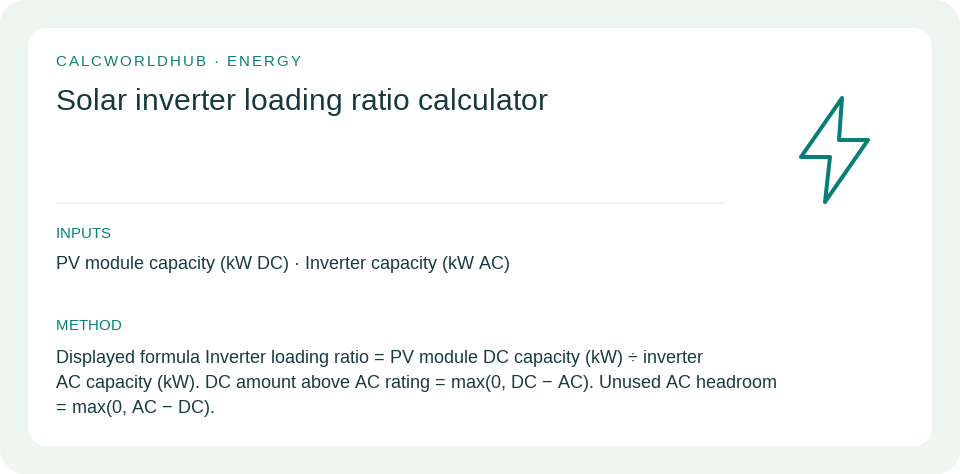
Inverter loading ratio = PV module DC capacity (kW) ÷ inverter AC capacity (kW). DC amount above AC rating = max(0, DC − AC). Unused AC headroom = max(0, AC − DC).
Method
Use nameplate capacities in the same power unit. Enter the combined module DC rating and the aggregate inverter AC rating; do not substitute measured energy for rated power.
Worked example
A 120 kW DC array connected to 100 kW AC of inverter capacity has an inverter loading ratio of 120 ÷ 100 = 1.20. The DC nameplate rating is 20 kW above the inverter AC rating.
Assumptions and limits
A ratio above 1 does not mean the system continuously produces more AC power than the inverter rating. Actual output depends on irradiance, temperature, orientation, losses, and inverter controls; clipping requires time-series or production modeling.
Frequently asked questions
Is an inverter loading ratio above 1 automatically wrong?
No. The ratio describes relative nameplate capacities. Appropriate sizing depends on the site, equipment, economics, and energy model.
Does the ratio tell me how much energy will be clipped?
No. Clipping depends on how often available DC output exceeds the inverter limit, which requires time-resolved irradiance and system modeling.
Should I use AC or DC module capacity?
Use the module array’s DC nameplate capacity and the inverter’s AC rating, as shown on their respective specifications.
How do I use the Solar inverter loading ratio calculator?
Enter PV module capacity (kW DC), Inverter capacity (kW AC). Match the units shown beside each field and review the result together with the assumptions below.
What is a worked example of Solar inverter loading ratio?
A 120 kW DC array connected to 100 kW AC of inverter capacity has an inverter loading ratio of 120 ÷ 100 = 1.20. The DC nameplate rating is 20 kW above the inverter AC rating.
Reference: National Renewable Energy Laboratory PV-AC-DC model. See our calculation methodology.