How to use this calculator
Estimate the pressure jump across a static spherical liquid droplet from radius and surface tension.
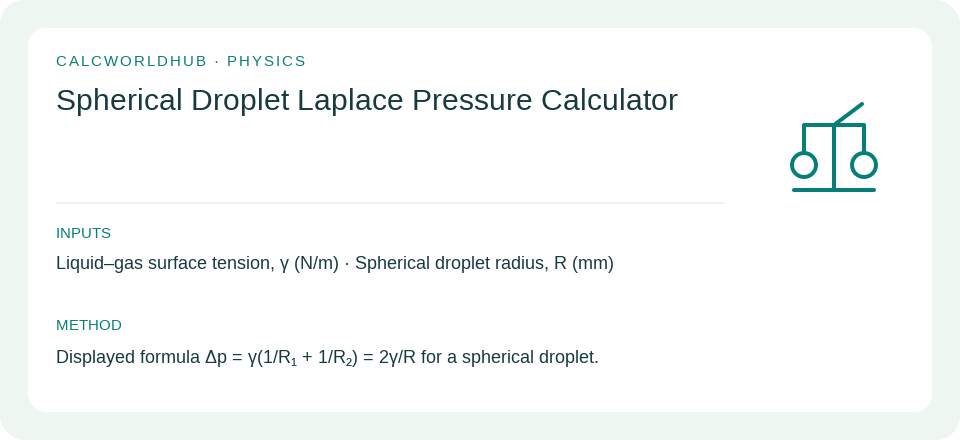
- Enter Liquid–gas surface tension, γ (N/m), Spherical droplet radius, R (mm). Match the units shown beside each field and review the result together with the assumptions below.
- Read the worked example below to check the expected input format and result.
- Compare another scenario by changing one input at a time. Use Reset to return to the starting values.
How this calculation works
Surface tension creates a pressure jump across a curved liquid interface. For a spherical liquid droplet with one interface, both principal curvature radii equal the droplet radius, so the Young–Laplace relation reduces to twice the surface tension divided by radius.
Inputs and units
surfaceTension— Liquid–gas surface tension, γ (N/m)- Surface tension for the liquid and surrounding gas at the temperature of interest.
radiusMm— Spherical droplet radius, R (mm)- Radius of curvature of the spherical droplet.
Formula
Δp = γ(1/R₁ + 1/R₂) = 2γ/R for a spherical droplet.
Method
Convert the entered radius from millimetres to metres and calculate the pressure inside the spherical droplet relative to the surrounding gas using one liquid–gas interface.
Worked example
With γ = 0.072 N/m and R = 1.0 mm, the pressure inside a static spherical liquid droplet is 144 Pa above the surrounding gas.
Assumptions and limits
Assumes a static spherical droplet, uniform surface tension, and negligible gravity-induced shape distortion. It reports the pressure inside a liquid droplet relative to the surrounding gas. A soap bubble has two interfaces and a different multiplier.
Frequently asked questions
Why does a smaller droplet have a larger pressure jump?
At a fixed surface tension, pressure is inversely proportional to radius of curvature.
Is this the soap-bubble formula?
No. This calculator models one liquid–gas interface. A thin soap bubble has two interfaces.
Can this predict the shape of a sessile drop?
No. It calculates the pressure jump for a spherical interface; a sessile drop may have non-spherical curvature and gravity effects.
How do I use the Spherical Droplet Laplace Pressure Calculator?
Enter Liquid–gas surface tension, γ (N/m), Spherical droplet radius, R (mm). Match the units shown beside each field and review the result together with the assumptions below.
What is a worked example of Spherical Droplet Laplace Pressure?
With γ = 0.072 N/m and R = 1.0 mm, the pressure inside a static spherical liquid droplet is 144 Pa above the surrounding gas.
Reference: technical reference. See our calculation methodology.