How to use this calculator
Infer interface thermal resistance and conductance from heat rate, temperature drop, and apparent contact area.
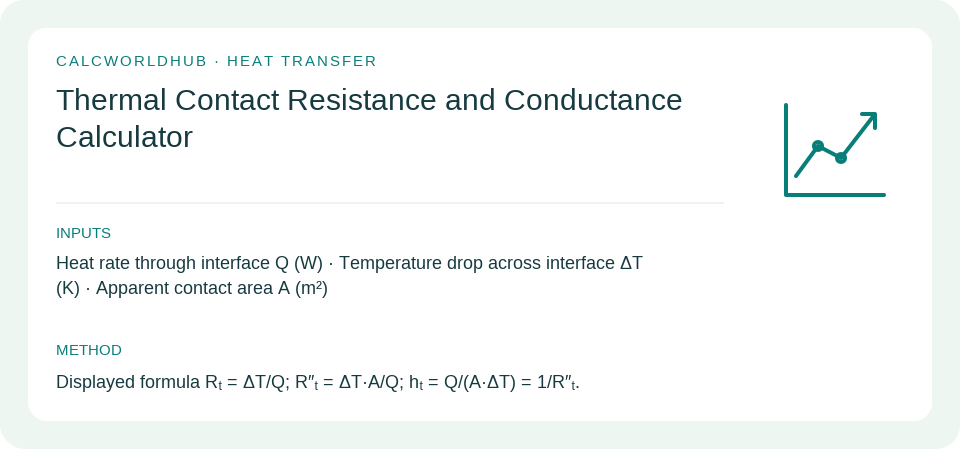
- Enter Heat rate through interface Q (W), Temperature drop across interface ΔT (K), Apparent contact area A (m²). Match the units shown beside each field and review the result together with the assumptions below.
- Read the worked example below to check the expected input format and result.
- Compare another scenario by changing one input at a time. Use Reset to return to the starting values.
How this calculation works
A thermal contact can produce a temperature drop even when two solid surfaces touch, because heat flows through a limited set of microscopic contact spots. From a measured steady heat rate and the temperature drop across the interface, this calculator reports the total contact resistance, area-specific resistance, and area-specific conductance. The area is the apparent interface area used to define heat flux.
Inputs and units
heatRate— Heat rate through interface Q (W)- Positive steady heat flow crossing the contact interface.
deltaT— Temperature drop across interface ΔT (K)- Use the magnitude of the temperature difference attributable to the interface.
area— Apparent contact area A (m²)- Nominal interface area used to convert heat rate to heat flux.
Formula
Rₜ = ΔT/Q; R″ₜ = ΔT·A/Q; hₜ = Q/(A·ΔT) = 1/R″ₜ.
Method
Divide the interface temperature drop by the total heat rate for K/W. Multiply total resistance by apparent area for m²K/W, then take its reciprocal for W/m²K conductance.
Worked example
With Q = 100 W, ΔT = 5 K, and A = 0.010 m², total resistance is 0.05000 K/W, area-specific resistance is 0.000500 m²K/W, and conductance is 2,000 W/m²K.
Assumptions and limits
Use a steady heat rate crossing the interface and the temperature difference attributable to that interface alone. The result is an effective value for the entered apparent area and operating condition; it does not predict contact conductance from pressure, roughness, materials, gap gas, or surface treatment.
Frequently asked questions
What is area-specific contact resistance?
It is total interface resistance multiplied by the apparent area, so it can be compared across interfaces with different nominal sizes.
How is contact conductance related to resistance?
Area-specific conductance is the reciprocal of area-specific resistance for the same interface and condition.
Can I use the temperature difference across an entire wall?
No. Use only the drop across the contact interface; a wall-wide temperature difference also includes layer and surface-film resistances.
How do I use the Thermal Contact Resistance and Conductance Calculator?
Enter Heat rate through interface Q (W), Temperature drop across interface ΔT (K), Apparent contact area A (m²). Match the units shown beside each field and review the result together with the assumptions below.
What is a worked example of Thermal Contact Resistance and Conductance?
With Q = 100 W, ΔT = 5 K, and A = 0.010 m², total resistance is 0.05000 K/W, area-specific resistance is 0.000500 m²K/W, and conductance is 2,000 W/m²K.
Reference: technical reference. See our calculation methodology.