How to use this calculator
Combine component tolerances to estimate assembly limits with worst-case and root-sum-square methods.
- Enter Nominal assembly dimension (mm), Component tolerances (mm, comma-separated). Match the units shown beside each field and review the result together with the assumptions below.
- Read the worked example below to check the expected input format and result.
- Compare another scenario by changing one input at a time. Use Reset to return to the starting values.
How this calculation works
An assembly gap or span can vary as component dimensions move within their specified limits. Worst-case analysis adds every absolute tolerance, while root-sum-square (RSS) combines independent symmetric contributors statistically and is not a guaranteed boundary.
Inputs and units
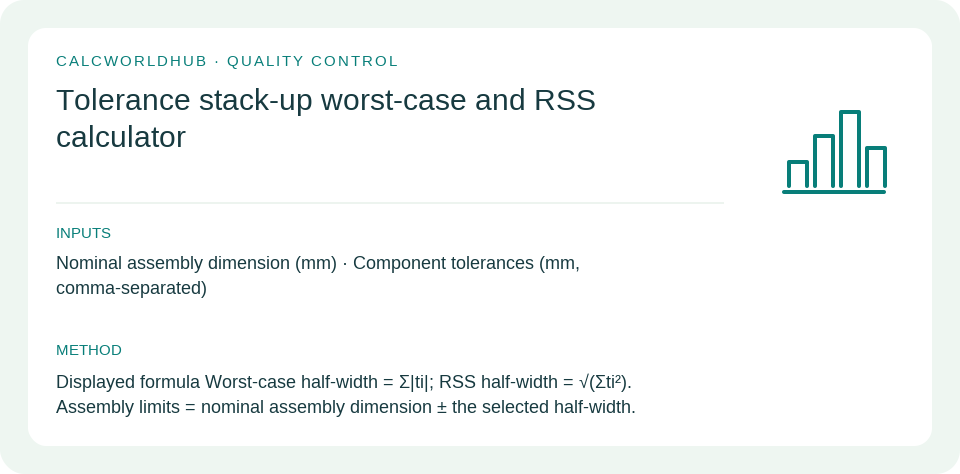
nominal— Nominal assembly dimension (mm)- Nominal gap, clearance, or span around which the tolerances accumulate.
tolerances— Component tolerances (mm, comma-separated)- Enter one positive symmetric tolerance magnitude per contributing dimension.
Formula
Worst-case half-width = Σ|ti|; RSS half-width = √(Σti²). Assembly limits = nominal assembly dimension ± the selected half-width.
Method
Enter the nominal assembly dimension and a comma- or space-separated list of positive symmetric component tolerance magnitudes in one unit. The calculator reports worst-case and RSS limits around the nominal.
Worked example
For a 5.00 mm nominal gap with tolerances ±0.10, ±0.10, and ±0.20 mm, the worst-case range is 4.60–5.40 mm; RSS is about 4.755–5.245 mm.
Assumptions and limits
The worst-case result assumes every contributor reaches its limiting direction at once. RSS is a statistical estimate that assumes independent, centered contributors; it is not a guaranteed fit limit and does not include process bias, correlation, or non-normal distributions.
Frequently asked questions
Is RSS a guaranteed worst-case limit?
No. RSS is a statistical combination under independence and centered-process assumptions; worst-case arithmetic gives the bounding stack.
Can tolerances be in inches?
Yes, if the nominal dimension and every tolerance use inches; the calculator will then display the same unit label, so convert the displayed unit consistently.
Should I enter plus/minus signs?
Enter positive tolerance magnitudes only. The formula applies both directions around the nominal dimension.
What if some dimensions subtract from the assembly gap?
Enter a correct nominal assembly dimension and use absolute tolerance contributors; the symmetric spread still accumulates by magnitude.
How do I use the Tolerance stack-up worst-case and RSS calculator?
Enter Nominal assembly dimension (mm), Component tolerances (mm, comma-separated). Match the units shown beside each field and review the result together with the assumptions below.
Reference: NASA lesson on worst-case and root-sum-square tolerance buildup. See our calculation methodology.