How to use this calculator
Calculate a relative WSJF priority score from cost-of-delay components and job size.
- Enter User/business value score, Time criticality score, Risk reduction / opportunity score, Relative job size. Match the units shown beside each field and review the result together with the assumptions below.
- Read the worked example below to check the expected input format and result.
- Compare another scenario by changing one input at a time. Use Reset to return to the starting values.
How this calculation works
Weighted Shortest Job First (WSJF) is a relative work-sequencing model. In the common SAFe estimate, relative cost of delay is divided by relative job duration or size.
Inputs and units
businessValue— User/business value score- Relative value score using the same scale as the other delay components.
timeCriticality— Time criticality score- Relative cost-of-delay score for timing sensitivity.
riskReduction— Risk reduction / opportunity score- Relative score for risk reduction and/or opportunity enablement.
jobSize— Relative job size- Positive relative estimate of job duration or size.
Formula
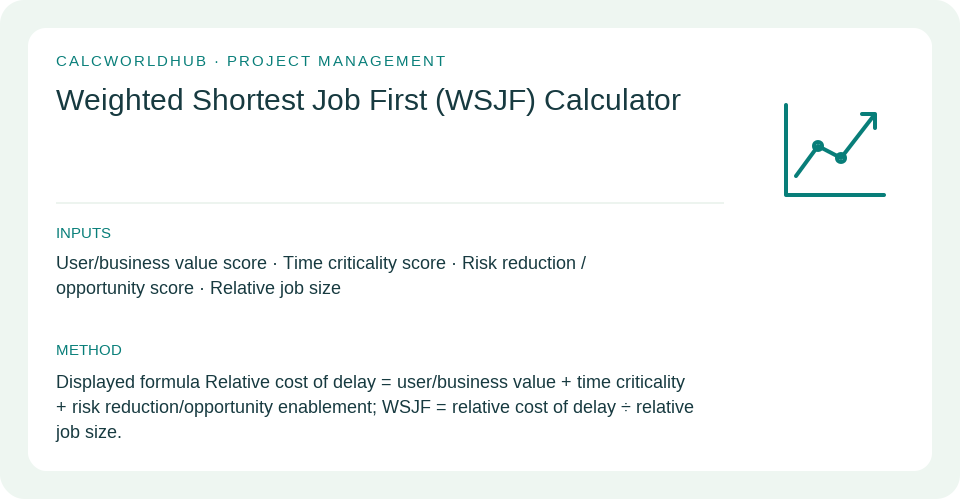
Relative cost of delay = user/business value + time criticality + risk reduction/opportunity enablement; WSJF = relative cost of delay ÷ relative job size.
Method
Enter three relative cost-of-delay scores and a positive relative job-size score on a consistent scale. The calculator sums the delay components, then divides by job size to produce a relative priority score.
Worked example
If relative delay scores are 8, 5, and 3, cost of delay is 16. With job size 4, WSJF = 16 ÷ 4 = 4.0.
Assumptions and limits
Scores are prioritization estimates, not currency amounts or objective probabilities. Compare jobs scored with the same criteria and scale; the output alone does not account for dependencies, capacity, or strategic constraints.
Frequently asked questions
Are these dollar values?
No. The components and job size are relative estimates, usually scored on a common scale.
What does a larger WSJF score mean?
It indicates more relative cost of delay per unit of job size under the chosen scoring assumptions.
Can I compare scores from different teams?
Only when teams use sufficiently consistent scoring criteria and scales.
How do I use the Weighted Shortest Job First (WSJF) Calculator?
Enter User/business value score, Time criticality score, Risk reduction / opportunity score, Relative job size. Match the units shown beside each field and review the result together with the assumptions below.
What is a worked example of Weighted Shortest Job First (WSJF)?
If relative delay scores are 8, 5, and 3, cost of delay is 16. With job size 4, WSJF = 16 ÷ 4 = 4.0.
Reference: Scaled Agile Framework definition of relative cost of delay divided by relative job duration. See our calculation methodology.