How to use this calculator
Sequence single-machine jobs to minimize total weighted completion time from processing times and priority weights.
- Enter Processing times (one per job, comma or space separated), Priority weights (in matching job order). Match the units shown beside each field and review the result together with the assumptions below.
- Read the worked example below to check the expected input format and result.
- Compare another scenario by changing one input at a time. Use Reset to return to the starting values.
How this calculation works
This tool applies Smith’s weighted shortest processing time rule to a set of jobs that are all ready at time zero. It sorts jobs by processing time divided by weight, then accumulates the completion time of each job in that order.
Inputs and units
processing— Processing times (one per job, comma or space separated)- Positive processing durations in the same time unit. Enter at least two jobs.
weights— Priority weights (in matching job order)- Positive, dimensionless importance weights. Match the processing-time list length and order.
Formula
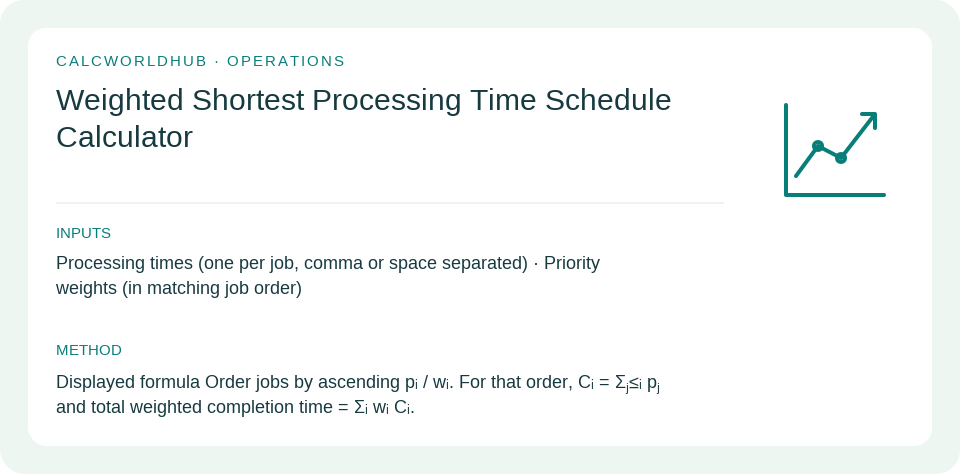
Order jobs by ascending pᵢ / wᵢ. For that order, Cᵢ = Σⱼ≤ᵢ pⱼ and total weighted completion time = Σᵢ wᵢ Cᵢ.
Method
A lower processing-time-to-weight ratio runs earlier. This is the optimal nonpreemptive sequence for one machine when every job is available at time zero and the objective is the sum of weighted completion times.
Worked example
For processing times 8, 4, 6, 2 and weights 1, 2, 1, 3, the order is J4, J2, J3, J1. Completion times are 2, 6, 12, 20 and the total weighted completion time is 50 weight·time units.
Assumptions and limits
The rule assumes one machine, no release dates, no precedence constraints, no preemption, and known processing times and nonnegative priority weights. It does not minimize due-date lateness or account for setup times.
Frequently asked questions
What does a job’s weight mean?
It is a relative penalty or importance multiplier for how long that job remains incomplete; keep the meaning and scale consistent across jobs.
Is this the same as earliest-due-date scheduling?
No. WSPT minimizes total weighted completion time. Earliest due date targets maximum lateness.
Can jobs arrive after scheduling starts?
This calculator assumes all jobs are ready at time zero. Release dates can change the optimal rule.
How do I use the Weighted Shortest Processing Time Schedule Calculator?
Enter Processing times (one per job, comma or space separated), Priority weights (in matching job order). Match the units shown beside each field and review the result together with the assumptions below.
What is a worked example of Weighted Shortest Processing Time Schedule?
For processing times 8, 4, 6, 2 and weights 1, 2, 1, 3, the order is J4, J2, J3, J1. Completion times are 2, 6, 12, 20 and the total weighted completion time is 50 weight·time units.
Reference: UC Berkeley Industrial Engineering and Operations Research weighted shortest processing time rule. See our calculation methodology.