How to use this calculator
Separate a pumping well step test into linear and quadratic drawdown components and evaluate the resulting operating-rate penalty.
- Enter Stabilized test pumping rates (m³/hour), Corresponding well drawdowns (m), Evaluation pumping rate (m³/hour). Match the units shown beside each field and review the result together with the assumptions below.
- Read the worked example below to check the expected input format and result.
- Compare another scenario by changing one input at a time. Use Reset to return to the starting values.
Well step drawdown loss coefficient fit explained
Fit the linear and quadratic well-loss terms to stabilized step-test drawdowns and evaluate the fitted drawdown at a selected pumping rate.
How the calculation works
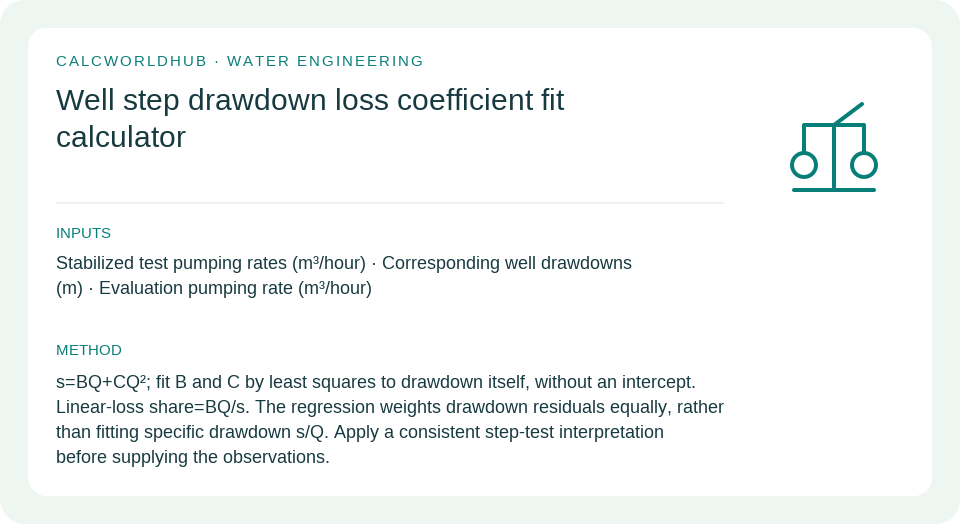
s=BQ+CQ²; fit B and C by least squares to drawdown itself, without an intercept. Linear-loss share=BQ/s.
The regression weights drawdown residuals equally, rather than fitting specific drawdown s/Q. Apply a consistent step-test interpretation before supplying the observations.
Set up the calculation
Q— Stabilized test pumping rates (m³/hour)- Positive distinct step rates after the selected stabilization or correction procedure. Use comma-separated values in the stated order.
s— Corresponding well drawdowns (m)- Drawdown in the pumping well for each rate, corrected consistently for transient carryover where required. Use comma-separated values in the stated order.
Qd— Evaluation pumping rate (m³/hour)- Rate at which the fitted linear-plus-quadratic well response is evaluated.
Limits of this model
Empirical quadratic well-loss model over the tested range. Transient carryover, changing aquifer response and extrapolation beyond tested pumping rates can invalidate the fit. Educational model; this is not a code-compliant design check.
Check this example
Stabilized test pumping rates (m³/hour) = [10, 20, 30, 40]; Corresponding well drawdowns (m) = [0.7, 1.8, 3.3, 5.2]; Evaluation pumping rate (m³/hour) = 25.
- Fitted operating drawdown: 2.5 m
- Linear loss coefficient B: 0.05 hour/m²
- Quadratic loss coefficient C: 0.002 hour²/m⁵
- Linear-loss share of drawdown: 50 %
Steps of 10, 20, 30 and 40 m³/h have drawdowns 0.7, 1.8, 3.3 and 5.2 m. These observations encode B=0.05 h/m² and C=0.002 h²/m⁵.
Reading the outputs
Operating drawdown is m; coefficients retain the stated hour-based units. The percentage describes the linear-loss fraction and is not pump energy efficiency.
Frequently asked questions
Is the linear share pump efficiency?
No. It partitions observed drawdown and says nothing about motor or impeller efficiency.
Why reject a negative quadratic coefficient?
It conflicts with the nonnegative additional well-loss model and usually signals data or model mismatch.
Can I combine observations from unrelated wells?
No. Both fitted coefficients characterize the same well and test interpretation.
How do I use the Well step drawdown loss coefficient fit calculator?
Enter Stabilized test pumping rates (m³/hour), Corresponding well drawdowns (m), Evaluation pumping rate (m³/hour). Match the units shown beside each field and review the result together with the assumptions below.
What is a worked example of Well step drawdown loss coefficient fit?
Stabilized test pumping rates (m³/hour) = [10, 20, 30, 40]; Corresponding well drawdowns (m) = [0.7, 1.8, 3.3, 5.2]; Evaluation pumping rate (m³/hour) = 25. Fitted operating drawdown: 2.5 m Linear loss coefficient B: 0.05 hour/m² Quadratic loss coefficient C: 0.002 hour²/m⁵ Linear-loss share of drawdown: 50 % Steps of 10, 20, 30 and 40 m³/h have drawdowns 0.7, 1.8, 3.3 and 5.2 m. These observations encode B=0.05 h/m² and C=0.002 h²/m⁵.
Background or definition reference: USGS Documentation of Spreadsheets for Analysis of Aquifer Tests.
Reference access note: The linked USGS aquifer-test reference could not be retrieved. The stated model equation and example were checked independently; consult the primary document before applying to a field test.