
A heat balance, not a scoop count
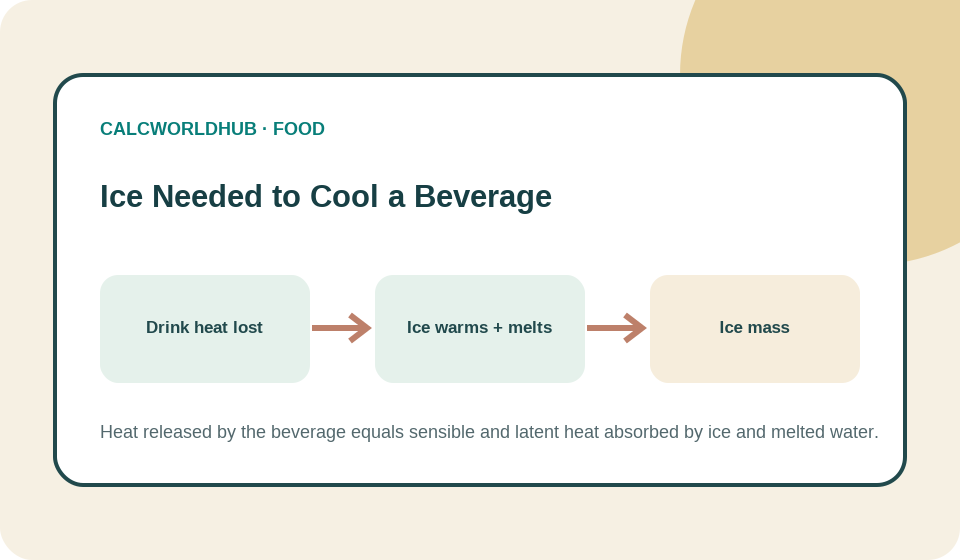
The calculator estimates ice mass by equating heat leaving a warm beverage with energy absorbed by ice. Inputs include beverage mass, starting and final temperatures, initial ice temperature, and the heat properties used for water and ice. The result includes energy to warm the ice, melt it, and warm the meltwater to the final temperature.
The model assumes a single beverage heat capacity and a final equilibrium temperature. It does not count cubes, size the scoop, or predict how long a drink stays cold. Density, dissolved sugar or milk, the glass, room heat, stirring, and heat exchange with the surroundings can change a real serving. Think of the result as an ideal mass estimate under the entered properties.
Understand the input units
Warm beverage mass is entered in kilograms; beverage, target, and ice temperatures are in degrees Celsius. Liquid and ice specific heat values are in kJ/kg/°C, while latent heat of fusion is in kJ/kg. These units make the numerator and denominator energies per mass consistent. The runtime accepts positive masses and heat properties, a nonnegative initial beverage temperature, a final temperature at or above 0°C, and ice temperature from −100°C to 0°C.
Use a target below the initial drink temperature for a cooling problem and keep it physically compatible with melting ice. The input fields allow a broad range, so a valid numerical response is not by itself proof that an unusual combination makes physical sense. The model’s all-ice-melts assumption applies when enough warm-liquid energy is available to bring the ice through melting and to the chosen final temperature.
Follow the energy terms
The drink releases mᵦ cₗ (Tᵢ − T𝒻). Ice absorbs cᵢ(0 − Tᵢce) while warming, L𝒻 while melting, then cₗT𝒻 as meltwater warms. Ice mass is drink heat released divided by those three ice-energy terms per kilogram. Keep temperature differences in °C and do not round terms before division.
NIST’s thermodynamic data and historical heat-capacity work provide reference context for the water and ice properties, but this interface asks you to supply those values. The default latent heat and heat capacities are approximations suitable for a planning estimate. If you enter different values, the output will change even when the beverage mass and temperatures stay the same; record the property source when precision matters.
Check whether the energy balance is feasible
If the drink begins only slightly above the target, it has limited heat to give and the ideal ice requirement should be small. A colder ice starting point absorbs additional sensible heat before melting, so less ice mass can be needed for the same beverage cooling, all else equal. A warmer target also reduces the drink’s heat loss and reduces the meltwater-warming term. These relationships are useful sanity checks before trusting a calculator result.
If the warm liquid cannot provide enough energy to melt all the ice and warm the meltwater to the specified endpoint, the physical outcome includes remaining ice or a different final temperature. The calculator’s formula is explicitly an all-melts balance and does not solve that alternative phase case. Avoid interpreting its output as valid for a combination that violates the assumed final state; choose a feasible target or use a model that handles remaining ice.
Worked examples
Both examples assume all ice melts; the calculation uses the full heat balance before rounding the ice mass.
Cooling half a kilogram from 22°C
Inputs: Drink mass = 0.5 kg; initial = 22°C; final = 6°C; ice = 0°C; liquid cp = 4.186 kJ/kg/°C; ice cp = 2.1; fusion = 333.55 kJ/kg.
Calculation: Ice mass = 0.5 × 4.186 × (22 − 6) ÷ [2.1 × (0 − 0) + 333.55 + 4.186 × 6] = 33.488 ÷ 358.666 ≈ 0.093368 kg.
The ideal balance calls for about 93 g of 0°C ice if all of it melts and the mixture reaches 6°C.
A larger drink with colder ice
Inputs: Drink mass = 0.75 kg; initial = 30°C; final = 8°C; ice = −5°C; liquid cp = 4.0 kJ/kg/°C; ice cp = 2.1; fusion = 333.55 kJ/kg.
Calculation: Ice mass = 0.75 × 4.0 × (30 − 8) ÷ [2.1 × 5 + 333.55 + 4.0 × 8] = 66 ÷ 376.05 ≈ 0.175509 kg.
The colder ice absorbs extra energy before melting, but the larger temperature drop and drink mass make this case require more ice overall.

Use the estimate in a real drink
Weigh beverage and ice rather than converting the result to a generic cube count. Cube dimensions, freezer temperature, stirring, contact area, and heat from the glass or room affect a real serving. A single liquid heat capacity also approximates drinks with milk, sugar, or other ingredients.
Check the mixed drink with a thermometer and record whether all ice melted. This is an ideal energy balance, not a serving-temperature promise or food-handling recommendation; real cups also gain or lose heat to their surroundings.