How to use this calculator
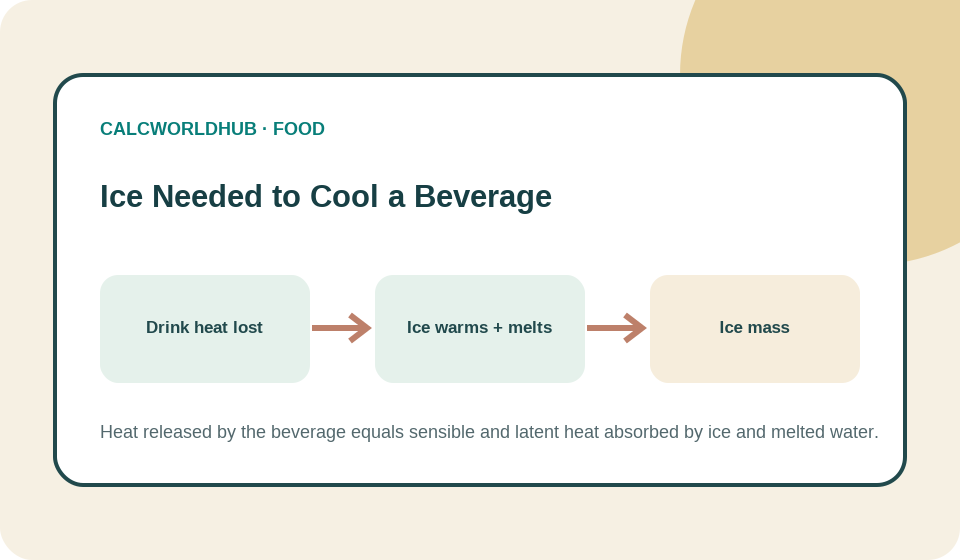
Balance beverage cooling against warming, melting, and subsequent warming of added ice.
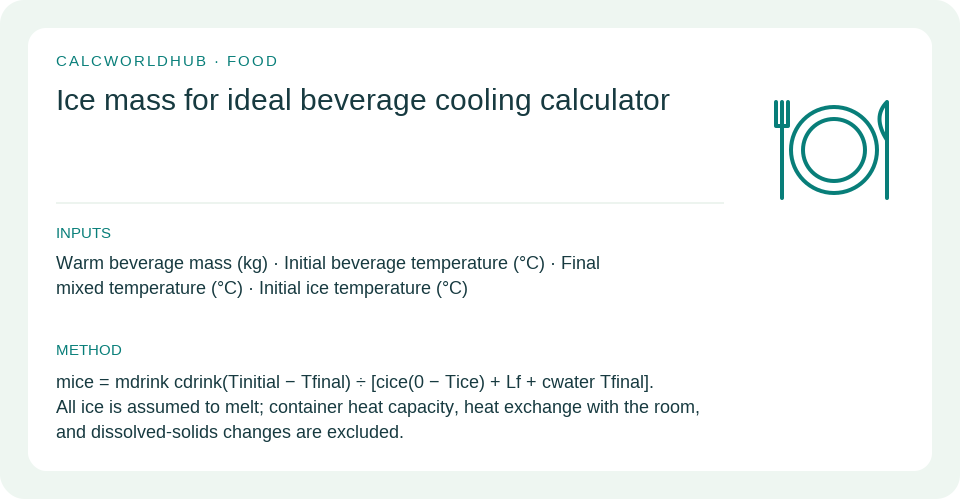
- Enter Warm beverage mass (kg), Initial beverage temperature (°C), Final mixed temperature (°C), Initial ice temperature (°C), then complete the remaining labeled fields. Match the units shown beside each field and review the result together with the assumptions below.
- Read the worked example below to check the expected input format and result.
- Compare another scenario by changing one input at a time. Use Reset to return to the starting values.
Ice mass for ideal beverage cooling explained
The estimate balances heat lost by the warm drink against ice warming to 0 °C, melting, and then warming as liquid to the target temperature. It assumes all ice melts and treats the drink’s specific heat as the entered liquid value.
Inputs, symbols, and units
m— Warm beverage mass (kg)- Warm beverage mass (kg).
hgt— Initial beverage temperature (°C)- Initial beverage temperature (°C).
t— Final mixed temperature (°C)- Final mixed temperature (°C).
ice— Initial ice temperature (°C)- Initial ice temperature (°C).
c— Liquid specific heat (kJ/kg/°C)- Liquid specific heat (kJ/kg/°C).
ci— Ice specific heat (kJ/kg/°C)- Ice specific heat (kJ/kg/°C).
lf— Ice latent heat of fusion (kJ/kg)- Ice latent heat of fusion (kJ/kg).
Formula and method
mice = mdrink cdrink(Tinitial − Tfinal) ÷ [cice(0 − Tice) + Lf + cwater Tfinal].
All ice is assumed to melt; container heat capacity, heat exchange with the room, and dissolved-solids changes are excluded.
A worked scenario
Warm beverage mass (kg) = 0.5; Initial beverage temperature (°C) = 80; Final mixed temperature (°C) = 10; Initial ice temperature (°C) = -10; Liquid specific heat (kJ/kg/°C) = 4.186; Ice specific heat (kJ/kg/°C) = 2.1; Ice latent heat of fusion (kJ/kg) = 333.55.
- Ideal ice mass required: 0.369592 kg
The drink releases 0.5×4.186×(80−10)=146.51 kJ/kg-scale heat. Each kilogram of ice absorbs 2.1×10+333.55+4.186×10=396.41 kJ, so the ideal ice mass is 146.51/396.41≈0.369592 kg.
Assumptions and edge cases
All ice is assumed to melt; container heat capacity, heat exchange with the room, and dissolved-solids changes are excluded.
Frequently asked questions
Is the final drink diluted?
Yes, melted ice becomes part of it.
Can I target a temperature below zero?
No, this fully melted-water model requires a nonnegative final temperature.
Does it include a hot cup?
No.
How do I use the Ice mass for ideal beverage cooling calculator?
Enter Warm beverage mass (kg), Initial beverage temperature (°C), Final mixed temperature (°C), Initial ice temperature (°C), then complete the remaining labeled fields. Match the units shown beside each field and review the result together with the assumptions below.
What is a worked example of Ice mass for ideal beverage cooling?
Warm beverage mass (kg) = 0.5; Initial beverage temperature (°C) = 80; Final mixed temperature (°C) = 10; Initial ice temperature (°C) = -10; Liquid specific heat (kJ/kg/°C) = 4.186; Ice specific heat (kJ/kg/°C) = 2.1; Ice latent heat of fusion (kJ/kg) = 333.55. Ideal ice mass required: 0.369592 kg The drink releases 0.5×4.186×(80−10)=146.51 kJ/kg-scale heat. Each kilogram of ice absorbs 2.1×10+333.55+4.186×10=396.41 kJ, so the ideal ice mass is 146.51/396.41≈0.369592 kg.
Read our calculation methodology.