How to use this calculator
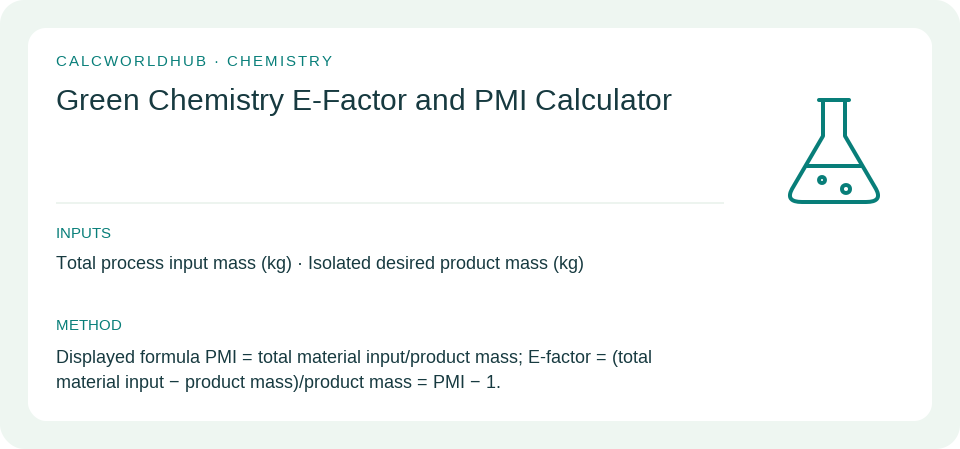
Calculate process mass intensity and E-factor from total process inputs and isolated product mass.
- Enter Total process input mass (kg), Isolated desired product mass (kg). Match the units shown beside each field and review the result together with the assumptions below.
- Read the worked example below to check the expected input format and result.
- Compare another scenario by changing one input at a time. Use Reset to return to the starting values.
How this calculation works
Process mass intensity (PMI) measures total process material input per product mass. The E-factor measures non-product waste per product mass for the same process boundary.
Inputs and units
inputMass— Total process input mass (kg)- Sum of material inputs included in the selected process boundary.
productMass— Isolated desired product mass (kg)- Mass of isolated desired product from the same batch.
Formula
PMI = total material input/product mass; E-factor = (total material input − product mass)/product mass = PMI − 1.
Method
Enter total materials charged to the process and the isolated desired product mass using the same mass units. The calculator treats all input mass not present in the desired product as waste under the selected boundary.
Worked example
With 1.5 kg of included process inputs and 0.8 kg of isolated product, PMI is 1.875 kg/kg, estimated waste is 0.7 kg, and E-factor is 0.875 kg/kg.
Assumptions and limits
Decide whether to include process water, solvents, catalysts, cleaning materials, and recovered streams before entering total input mass. The result is a mass metric, not a toxicity, energy, carbon, or life-cycle impact score. It differs from theoretical atom economy.
Frequently asked questions
Should I include water?
Use the boundary required by your reporting method. Some E-factor conventions exclude water, while PMI is often reported with a broader input boundary.
How is this different from atom economy?
Atom economy is a theoretical stoichiometric property of a balanced reaction. PMI and E-factor use actual process input and isolated product masses.
Does the E-factor measure environmental harm?
No. It measures waste mass per product mass and does not represent waste toxicity or environmental impact.
How do I use the Green Chemistry E-Factor and PMI Calculator?
Enter Total process input mass (kg), Isolated desired product mass (kg). Match the units shown beside each field and review the result together with the assumptions below.
What is a worked example of Green Chemistry E-Factor and PMI?
With 1.5 kg of included process inputs and 0.8 kg of isolated product, PMI is 1.875 kg/kg, estimated waste is 0.7 kg, and E-factor is 0.875 kg/kg.
Reference: ACS Sustainable Chemistry review defining E-factor and process mass intensity. See our calculation methodology.