How to use this calculator
Estimate the liquid-water depth stored in a snowpack from measured snow depth and bulk density.
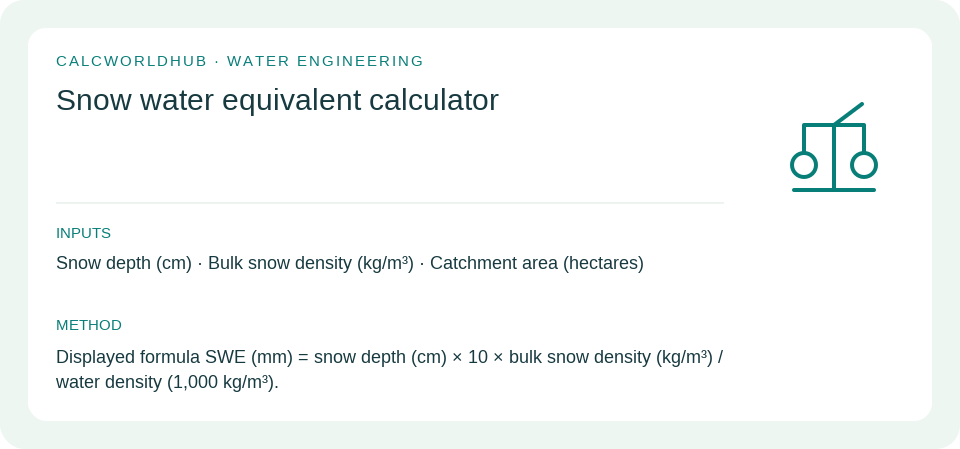
- Enter Snow depth (cm), Bulk snow density (kg/m³), Catchment area (hectares). Match the units shown beside each field and review the result together with the assumptions below.
- Read the worked example below to check the expected input format and result.
- Compare another scenario by changing one input at a time. Use Reset to return to the starting values.
How this calculation works
Snow water equivalent (SWE) expresses the water stored in snow as the depth it would have after melting over the same area. It is useful for comparing snowpacks with different depths and densities in runoff and water-supply planning.
Inputs and units
depth— Snow depth (cm)- Vertical depth of the snowpack at the measurement point.
density— Bulk snow density (kg/m³)- Average mass per total snowpack volume, including pore space.
area— Catchment area (hectares)- Optional area used to convert SWE depth to an equivalent water volume.
Formula
SWE (mm) = snow depth (cm) × 10 × bulk snow density (kg/m³) / water density (1,000 kg/m³).
Method
Convert snow depth to millimeters and multiply by the snowpack-to-water density ratio. The result is a water-equivalent depth over the same horizontal area.
Worked example
A 40 cm snowpack with a representative bulk density of 250 kg/m³ contains an estimated 100 mm of water equivalent. Over one hectare, that is approximately 1,000 m³ of water.
Assumptions and limits
Assumes the entered density is representative bulk density for the entire measured snow column. Layering, meltwater, ice lenses, spatial variability, and sampling error are not modeled; an instrument or core measurement is preferable for operational forecasting.
Frequently asked questions
Is snow water equivalent the same as snow depth?
No. SWE accounts for density and represents the meltwater depth; deep light snow can contain less water than shallow dense snow.
Does this estimate predict runoff?
No. It estimates stored water only. Runoff timing and volume depend on infiltration, melt rate, soil, vegetation, storage, and watershed conditions.
What density should I enter?
Use a measured representative bulk density for the snow column. A single point may not represent a large or layered snowpack.
How do I use the Snow water equivalent calculator?
Enter Snow depth (cm), Bulk snow density (kg/m³), Catchment area (hectares). Match the units shown beside each field and review the result together with the assumptions below.
What is a worked example of Snow water equivalent?
A 40 cm snowpack with a representative bulk density of 250 kg/m³ contains an estimated 100 mm of water equivalent. Over one hectare, that is approximately 1,000 m³ of water.
Reference: NOAA snow-water-equivalent measurement definition. See our calculation methodology.