Sports calculator guides
Explore 23 practical guides with worked examples, clear assumptions, and direct links to the calculators they explain.
Showing 13–23 of 23 articles
Interval Work-to-Rest Ratio from Work and Recovery Time
Compare one interval’s work duration with its following recovery time, while keeping the ratio separate from training intensity.
Read article
Basketball Free Throw Percentage from Makes and Attempts
Calculate free throw accuracy for a defined player, team, or game sample while keeping makes and attempts on the same statistical basis.
Read article
Basketball Points per Possession from Points and Possessions
Normalize a team or play sample by its possessions to calculate points per possession and points per 100 possessions.
Read article
Bicycle Gear Development Distance per Crank Revolution
Estimate wheel travel per crank revolution from the entered rear-wheel circumference and front-to-rear tooth ratio.
Read article
Interval Training Session Total Duration from Repeats
Add repeated work intervals, recovery between repetitions, and combined warm-up and cool-down time into a session-duration estimate.
Read article
Interval Work Distance from Repeat Distance and Count
Sum the distance assigned to each work interval, while distinguishing that subtotal from warm-up, recovery, and total-session mileage.
Read article
Epley One-Rep Max Estimate: Use a Submaximal Set Carefully
Estimate an Epley one-repetition maximum from a completed lifting set, understand the equation, and see why the result is a planning estimate rather than a tested max.
Read article
Swim Pace per 100 Metres: Convert Total Time and Distance
Convert an elapsed swim time and distance into average minutes and seconds per 100 metres, then compare swims on a consistent distance basis.
Read article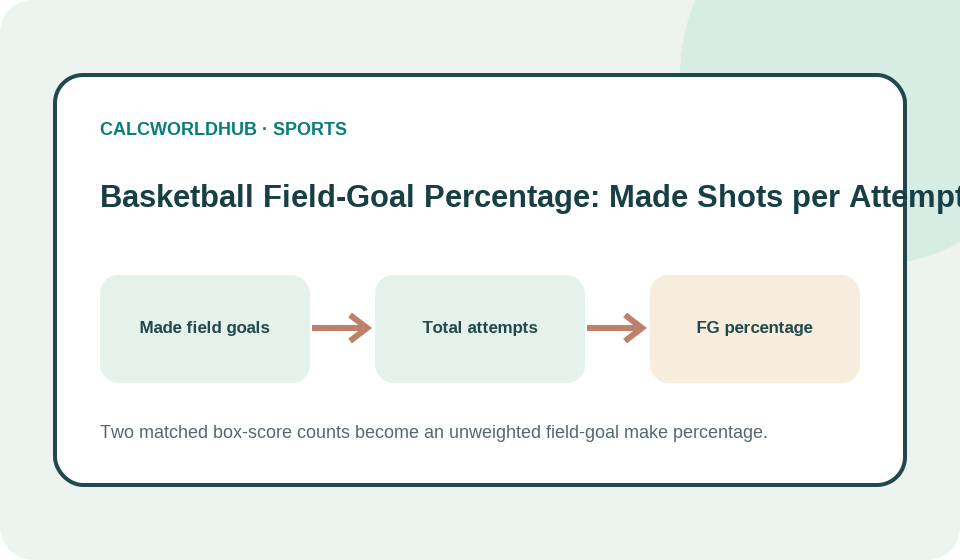
Basketball Field-Goal Percentage: Made Shots per Attempt
Calculate field-goal percentage from made shots and attempts, and distinguish this simple shooting rate from a points-weighted measure.
Read article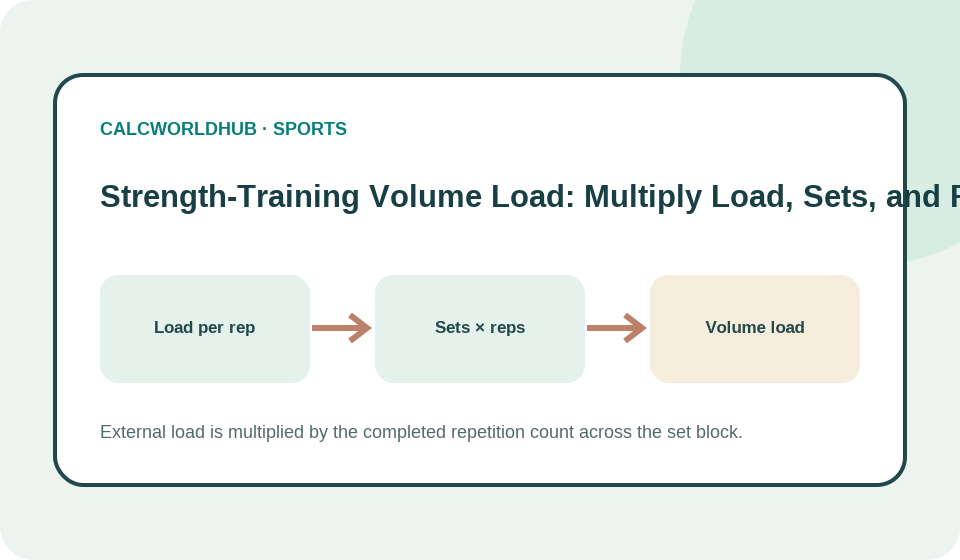
Strength-Training Volume Load: Multiply Load, Sets, and Repetitions
Calculate external lifting volume load from load, completed sets, and repetitions per set, while recognizing what this simple total leaves out.
Read article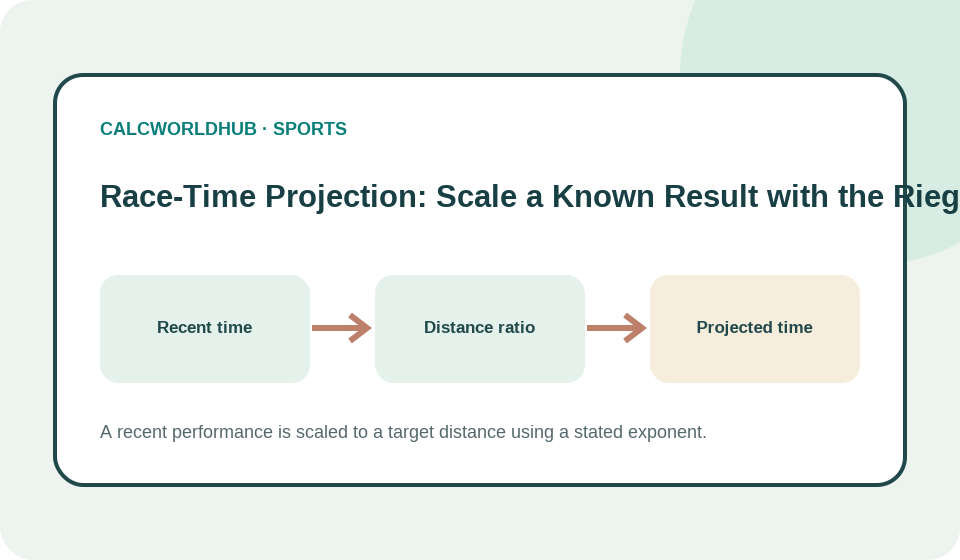
Race-Time Projection: Scale a Known Result with the Riegel Model
Project a time at another race distance from one recent result using the Riegel power-law model and an explicitly chosen distance exponent.
Read article